Many writers and students struggle with “alot or a lot”, often mistaking one for the other. This is a common question in English because the words sound the same, but only one is correct.
People search for “alot or a lot” to clarify spelling, improve professional writing, and avoid embarrassment in emails, assignments, and social media posts.
This guide provides a clear explanation, examples, and tips to help you confidently write a lot the right way.
Alot or A Lot – Quick Answer
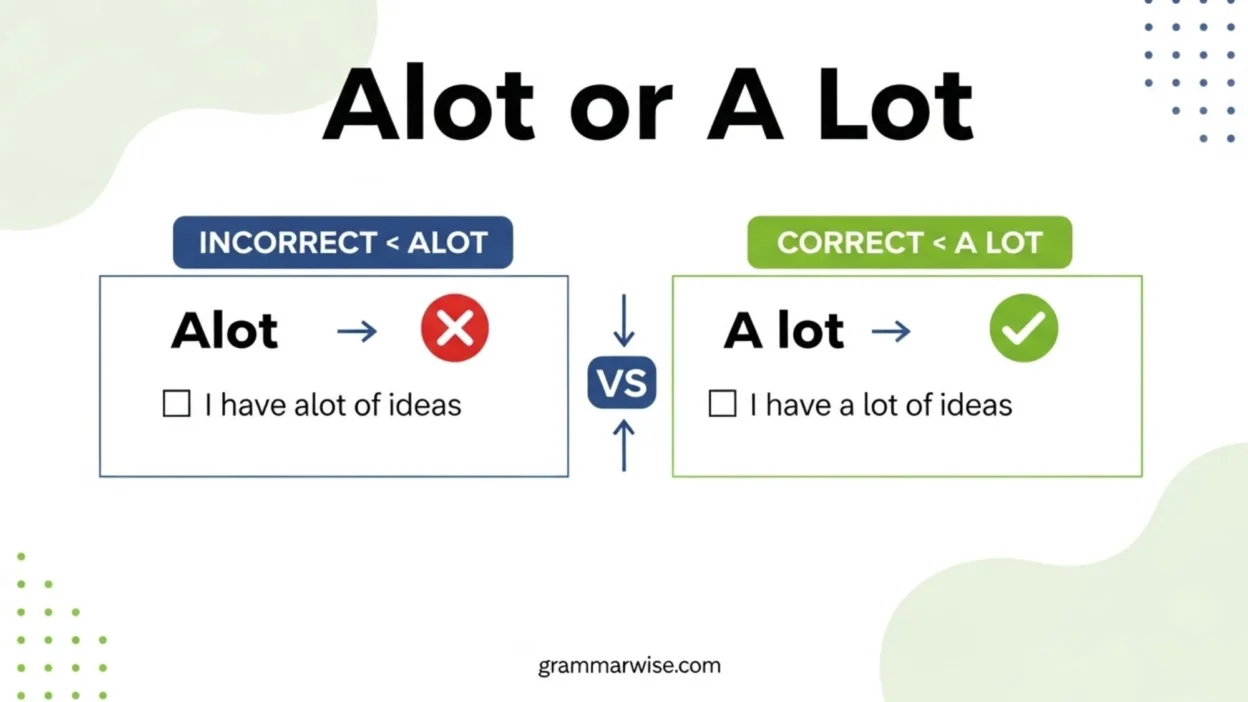
- Alot → ❌ Incorrect. It is not a word in standard English.
- A lot → ✔ Correct. Means “many” or “a large amount.”
Example: She has a lot of books.
Example: I like you a lot.
Quick Tip: Always write it as two separate words: a lot.
The Origin of Alot or A Lot
The confusion comes from the fact that in spoken English, “a lot” sounds like “alot”. Early English writing never combined the words, but informal online writing and texting sometimes use alot.
Modern English dictionaries and grammar guides clearly mark alot as incorrect. The correct form, a lot, has been used for centuries to indicate quantity or intensity.
British English vs American English Spelling
Both British and American English use a lot and reject alot. There is no difference in rules between the two: it is universally written as a lot in formal and informal contexts.
Comparison Table:
| Form | Meaning | Example | UK Usage | US Usage |
|---|---|---|---|---|
| alot | ❌ Incorrect | ❌ I have alot of ideas. | ❌ | ❌ |
| a lot | ✔ Many / large amount | ✔ I have a lot of ideas. | ✔ | ✔ |
Which Spelling Should You Use?
- United States: Always use a lot; avoid alot.
- United Kingdom & Commonwealth: Same rule applies.
- Global Audience: Use a lot in all formal writing, emails, and publications.
Common Mistakes with Alot or A Lot
- Writing alot in essays or emails:
❌ I have alot of work. → ✅ I have a lot of work. - Combining with adjectives incorrectly:
❌ She is alotal happy. → ✅ She is a lot happier. - Overusing in formal writing:
❌ There are a lot of solutions. → ✅ Many solutions exist.
Alot or A Lot in Everyday Examples
- Emails: Thank you for a lot of support.
- Social Media: I love this place a lot!
- News Articles: The city received a lot of rain last week.
- Formal Writing: The study provided a lot of evidence.
Alot or A Lot – Google Trends & Usage Data
Search interest for “alot or a lot” peaks during school semesters and online content creation. U.S., U.K., Canada, and Australia lead in searches. The incorrect alot appears often in casual social media posts, blogs, and text messages.
Keyword Variation Table:
| Variation | Popularity | Usage Example |
|---|---|---|
| alot | Low (incorrect) | ❌ I have alot of ideas. |
| a lot | High (correct) | ✔ I have a lot of ideas. |
FAQs
1. Is “alot” a word?
No, alot is incorrect. Always write a lot.
2. Can “a lot” be used in formal writing?
Yes, but consider alternatives like “many” or “numerous” for very formal texts.
3. Why do people write “alot”?
Because “a lot” sounds like alot in speech, leading to informal spelling mistakes.
4. Is there a difference between UK and US English?
No, both use a lot and reject alot.
5. Can I hyphenate it as “a-lot”?
No, hyphenation is incorrect; always use two words: a lot.
6. How can I remember the correct spelling?
Think “two words” – a lot, never one.
Conclusion
Understanding the difference between alot and a lot is simple but important. Remember: alot is never correct.
Use a lot to indicate many, much, or a large amount. This rule applies in all forms of English, whether in casual texts, social media, emails, or professional writing.
With this guide, you can confidently write a lot without fear of making mistakes. Clear writing builds credibility, and knowing the right form ensures your communication is polished and professional.

Hi, I’m Jason Carter, the author behind GrammarNestly.com.
I’m a grammar expert with a passion for helping readers understand the English language in a simple and practical way.
I love breaking down confusing grammar rules and turning them into easy, everyday lessons that anyone can follow.