Have you ever typed combatting and wondered if it’s a typo? You’re not alone.
Writers, students, and professionals often pause mid-sentence, unsure whether to use combatting or combating.
The truth is — both spellings are correct, but their usage depends on where your readers are.
If you’re someone who writes emails, blogs, or reports for an international audience, this quick guide will clear your confusion and help you pick the right spelling confidently every time.
Combatting or Combating – Quick Answer
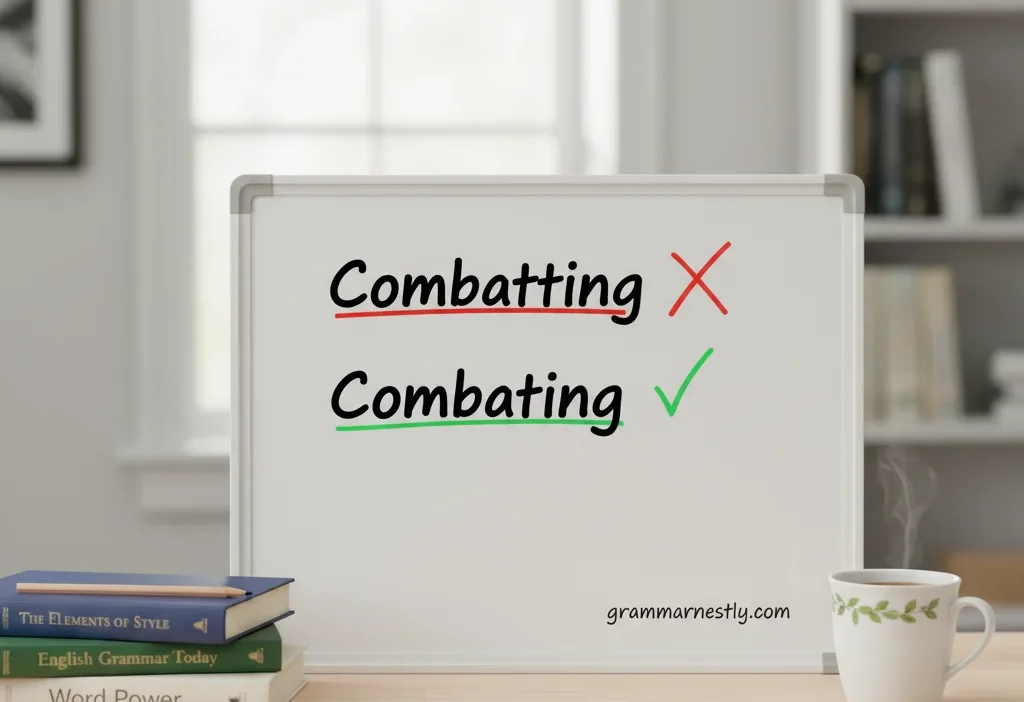
✅ “Combating” is the correct and preferred spelling in American English.
✅ “Combatting” (with a double “t”) is used in British English and other Commonwealth countries.
Examples:
- US: The government is combating climate change.
- UK: The government is combatting climate change.
👉 So both spellings are correct — but which one you use depends on where your readers are.
The Origin of “Combatting” and “Combating”
Both words come from the verb “combat”, meaning to fight against something harmful or dangerous.
It entered English from the French word combattre, meaning to fight.
When you add “-ing” to a verb ending in a single consonant, English spelling rules vary between dialects:
- British English often doubles the final consonant if the word ends in a single vowel + consonant.
- American English usually does not double the consonant unless it’s a stressed syllable (e.g., “forget → forgetting”).
That’s why you see:
- British: combat → combatting
- American: combat → combating
Historically, both spellings appeared in 19th-century texts, but “combating” became dominant globally due to American influence in publishing and journalism.
British English vs American English Spelling
Here’s a clear comparison between both versions:
| Region | Correct Spelling | Example Sentence | Notes |
|---|---|---|---|
| 🇺🇸 American English | Combating | The team is combating misinformation online. | Preferred in U.S. writing. |
| 🇬🇧 British English | Combatting | The charity is combatting hunger across the region. | Common in the UK and Commonwealth. |
| 🌍 International/Global English | Combating | The world is combating climate change together. | Most accepted in global publications. |
Summary:
👉 Use combating for most audiences.
👉 Use combatting only if your readers are mainly British or Commonwealth-based.
Which Spelling Should You Use?
It depends entirely on your target audience and writing context.
- If you write for an American audience:
Always use combating.
(Example: “The U.S. military is combating cyber threats.”) - If you write for a British or Commonwealth audience:
You can use combatting.
(Example: “The UK is combatting rising inflation.”) - If your audience is international or you publish online:
Choose combating, as it’s recognized and accepted worldwide.
Pro tip:
Most style guides — including the Associated Press (AP) and Chicago Manual of Style (CMOS) — recommend combating as the default form.
Common Mistakes with Combatting or Combating
Here are a few frequent mix-ups and how to correct them:
| ❌ Wrong | ✅ Correct | Explanation |
|---|---|---|
| The police are combatting crime (US website). | The police are combating crime. | “Combating” is the US form. |
| We’re combating disease in Africa (British NGO). | We’re combatting disease in Africa. | “Combatting” suits UK/Commonwealth use. |
| The country is combating corruption. | The country is combating corruption. | Never separate with a hyphen. |
📝 Tip:
Always match your spelling to your audience’s region and follow one consistent style throughout your content.
Combatting or Combating in Everyday Examples
Here are real-world examples showing how both spellings are used in different contexts:
| Context | Sentence Example | Spelling Used | Region |
|---|---|---|---|
| 📰 News (US) | “The CDC is combating the spread of new viral infections.” | Combating | 🇺🇸 United States |
| 🗞️ News (UK) | “Local councils are combatting rising air pollution.” | Combatting | 🇬🇧 United Kingdom |
| “We’re dedicated to combating misinformation across platforms.” | Combating | 🌎 Global/US | |
| 🤝 Nonprofit | “Our organization focuses on combatting poverty through education.” | Combatting | 🇬🇧 UK/Commonwealth |
| 🎓 Academic | “Researchers are combating antibiotic resistance.” | Combating | 🌍 International |
| 📱 Social Media | “Small steps in recycling mean we’re all combating climate change together.” | Combating | 🌎 Glo |
No matter which version you use, the message remains the same — it’s all about fighting against something harmful or negative.
Combatting or Combating – Google Trends & Usage Data
Let’s look at how both spellings perform globally 👇
| Word | Popularity | Region | Common Usage |
|---|---|---|---|
| Combating | 🌎 Very high | U.S., Canada, Asia | Standard in digital and global writing |
| Combatting | 🇬🇧 Moderate | UK, Australia, New Zealand | Seen in formal British and NGO writing |
📊 Google Trends Insight:
- Combating dominates worldwide searches, especially in academic and global English contexts.
- Combatting still appears in UK and Commonwealth sources but makes up less than 20% of total global usage.
FAQs about “Combatting” vs “Combating”
1. Which is correct: combatting or combating?
Both are correct — combating is the American spelling, combatting is the British spelling.
2. Why does American English drop one “t”?
American English simplifies spelling by removing double consonants when the final syllable isn’t stressed.
3. Can I use both forms interchangeably?
Not in the same document. Choose one version and stay consistent throughout.
4. Is “combatting” wrong in the U.S.?
It’s not technically wrong, but it’s considered nonstandard or old-fashioned.
5. Do grammar checkers flag “combatting”?
Yes — U.S.-based tools like Grammarly or Word often flag it as incorrect.
6. Which form is more popular online?
“Combating” — it appears in about 90% of global web pages and official publications.
7. Is the pronunciation different?
No, both are pronounced the same: kuhm-BAT-ing.
Conclusion
The difference between combatting and combating is about region, not correctness.
Use combating in the U.S. or global writing, and combatting in British or Commonwealth contexts.
Both mean “to fight against” something harmful — like disease or crime.
Stay consistent with your audience, and you’ll always use the right form confidently.

Hi, I’m Jason Carter, the author behind GrammarNestly.com.
I’m a grammar expert with a passion for helping readers understand the English language in a simple and practical way.
I love breaking down confusing grammar rules and turning them into easy, everyday lessons that anyone can follow.