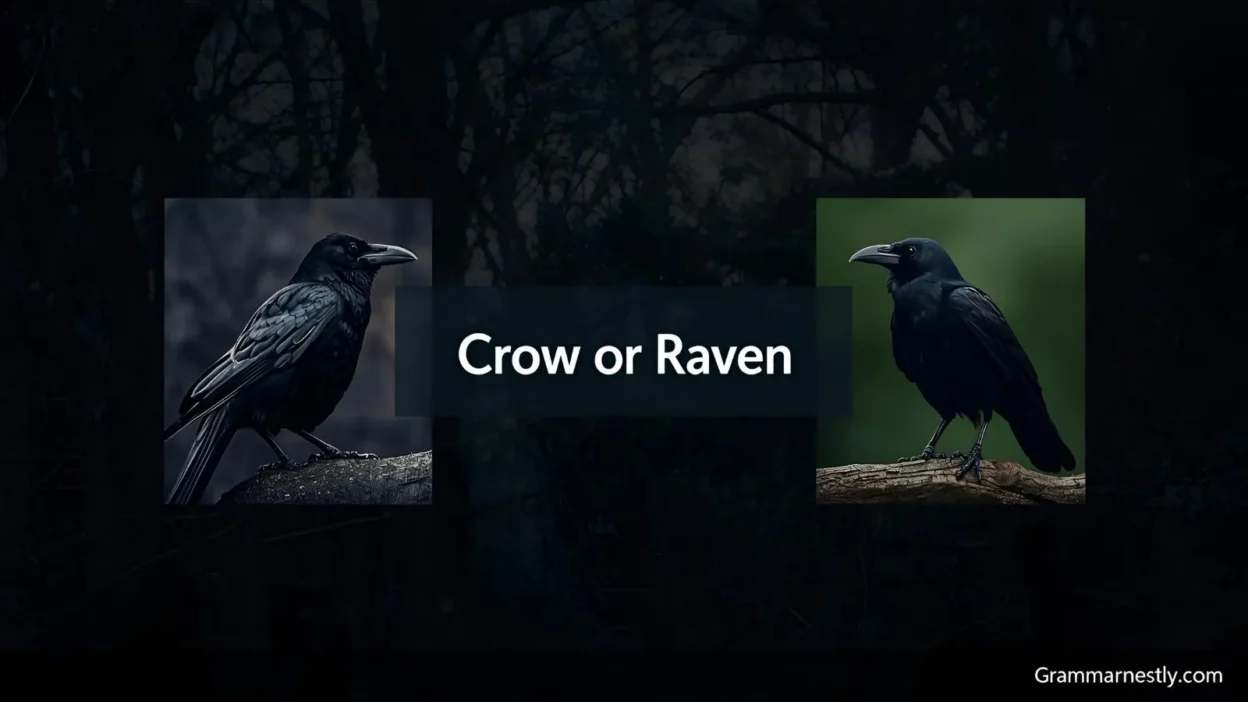
Have you ever seen a black bird and wondered, “Is that a crow or raven?” 🪶 I know I have, and it can be really confusing.
Both birds are dark, mysterious, and often appear in stories or myths, but they are not the same.
In this guide, I’ll help you quickly spot the difference, understand when to use crow or raven, and make sure you never mix them up again.
Let’s settle this question once and for all!
Crow or Raven – Quick Answer ⚡
A crow is smaller and says “caw.”
A raven is larger and makes a deep “croak.”
Crows love city life. Ravens prefer wild, open spaces.
Examples:
- ✅ “A crow perched on the telephone wire.”
- ✅ “A raven flew across the canyon.”
| Feature | Crow | Raven |
|---|---|---|
| Size | Smaller (40–50 cm) | Larger (55–70 cm) |
| Tail Shape | Fan-shaped | Wedge-shaped |
| Sound | “Caw, caw” | Deep “Croak” |
| Habitat | Towns, farms | Cliffs, forests |
| Group Name | Murder of crows | Unkindness of ravens |
👉 Quick tip: If it’s huge, croaking, and flying solo — it’s probably a raven!
The Origin of “Crow” and “Raven” 📜
Both words are ancient — over a thousand years old!
- Crow comes from Old English crāwe, meaning “the calling bird,” inspired by its loud caw.
- Raven comes from Old English hræfn, meaning “dark bird.”
So their names came from the way they sound and look — not from spelling rules. Unlike many English mix-ups, crow and raven are completely different species, not alternate spellings of one another.
Fun fact: In Norse mythology, Odin had two ravens — Huginn (thought) and Muninn (memory). Crows, meanwhile, often appear in daily life and folk tales about cleverness.
British vs American English 🇬🇧🇺🇸
Good news — spelling doesn’t change! ✨
Both crow and raven are spelled the same in every English-speaking country.
What changes is usage and culture:
| Type of English | Common Use | Example Sentence |
|---|---|---|
| British English | Ravens often linked with legends or myths | “The ravens guard the Tower of London.” |
| American English | Crows seen as everyday city birds | “A crow cawed on the power line.” |
While British writers may use raven in poetry and fantasy, Americans talk about crows more often in daily speech.
👉 Tip: When writing for a global audience, mention both — “crows and ravens” — for clarity.
Which Word Should You Use? 🎯
Use crow if:
- You’re talking about smaller birds near towns.
- You mean intelligence, playfulness, or daily sightings.
Use raven if:
- You’re writing about wild birds, myths, or mystery.
- You want a deeper, darker, or poetic tone.
Examples:
- ✍️ “A crow stole my fries at the park.”
- ✍️ “The raven appeared in my dream last night.”
Both are correct — just pick the one that fits your scene or message best.
Common Mistakes with Crow or Raven 🚫
- Thinking they’re the same bird.
Nope! All ravens are corvids, but not all corvids are ravens. - Mixing up size.
Ravens are always larger and heavier. - Wrong sound.
Crow = “Caw.” Raven = “Croak.” - Using the wrong symbolism.
- Crow → cleverness, curiosity, teamwork.
- Raven → mystery, prophecy, solitude.
- Assuming spelling differs.
Both spellings are identical across all dialects.
Keep these five in mind and you’ll never mix them up again!
Crow or Raven in Everyday Use ✍️
Here’s how you’ll see the words used:
- Emails: “I heard a crow outside my window this morning.”
- News: “Ravens return to Scotland after 150 years.”
- Social Media: “Some days I’m a crow — loud and curious. Other days I’m a raven — quiet but deep.”
- Formal Writing: “The raven holds symbolic power in many ancient cultures.”
Crows appear in casual, real-world writing. Ravens show up more in literature and art. Both are popular in memes, poetry, and captions.
Crow or Raven – Google Trends & Usage Data 🌍
According to Google Trends (2025 data):
- Crow dominates searches in the US, India, and Canada.
- Raven trends higher in the UK, Scandinavia, and Northern Europe, where it carries mythic meaning.
| Country | Most Searched Term | Main Context |
|---|---|---|
| USA | Crow | Everyday bird |
| UK | Raven | Myths & legends |
| India | Crow | Common bird |
| Norway | Raven | Norse culture |
| Canada | Crow | Nature & symbolism |
Overall, crow gets more casual searches, but raven wins in poetry, tattoos, and symbolism posts.
Symbolism & Meaning 🌑
- Crow: cleverness, adaptability, teamwork, humor.
- Raven: mystery, transformation, magic, solitude.
Writers often use ravens to create mood and depth, while crows appear in modern, witty contexts — like “crow memes” or “crow logic.”
Both birds are highly intelligent and can recognize faces, use tools, and solve puzzles — a true marvel of nature!
Crow or Raven Comparison Table 📊
| Feature | Crow | Raven |
|---|---|---|
| Scientific Genus | Corvus brachyrhynchos | Corvus corax |
| Average Length | 40–50 cm | 55–70 cm |
| Average Weight | 300–600 g | 800–1500 g |
| Voice | Sharp “Caw” | Deep “Croak” |
| Tail Shape | Rounded/Fan | Wedge |
| Group Name | Murder | Unkindness |
| Symbolism | Cleverness | Mystery |
| Habitat | Urban, suburban | Mountains, forests |
FAQs About “Crow or Raven” 🧠
1. Are crows and ravens related?
Yes. Both belong to the Corvus genus but are separate species.
2. Which one is smarter?
Both are brilliant, but ravens often show more problem-solving skill.
3. Can they mimic human speech?
Yes! Ravens can mimic voices and sounds even better than parrots.
4. Why are ravens linked with death?
Their dark color and mythic presence made them symbols of mystery and transition.
5. What’s a group of crows called?
A “murder.” 🖤
6. What’s a group of ravens called?
An “unkindness” or “conspiracy.”
7. Which bird brings good luck?
Depends on culture — in some Asian beliefs, crows bring messages and protection.
Conclusion 🌤️
So, crow or raven? You can finally tell!
Crows are the chatty, clever city birds. Ravens are their larger, deeper-voiced cousins of the wild. Both are amazing, intelligent creatures that deserve admiration — not fear.
When writing or talking, use crow for common black birds and raven when describing mystery, legends, or poetry.
👉 Quick takeaway:
Crow = small, curious, clever.
Raven = big, bold, mysterious.
Language is powerful — and so are the birds that inspired it.

Hi, I’m Ernest Hemingway, the author of GrammarNestly.com.
I’m a grammar expert and language enthusiast who loves making English simple and practical.
When I’m not writing about grammar, I enjoy reading, exploring new writing styles, and helping others improve their communication skills.