Ever paused mid-sentence wondering whether to write desert or dessert? You’re not alone, because this tiny spelling difference confuses millions.
People often search this keyword to avoid embarrassing mistakes in emails, essays, and social posts. The words sound similar, but their meanings couldn’t be more different.
This blog makes it simple by breaking down the difference in a clear, friendly way. You’ll learn quick tricks to remember the correct spelling every time.
By the end, you’ll never mix up desert or dessert again. Let’s fix this confusion once and for all.
Desert or Dessert – Quick Answer
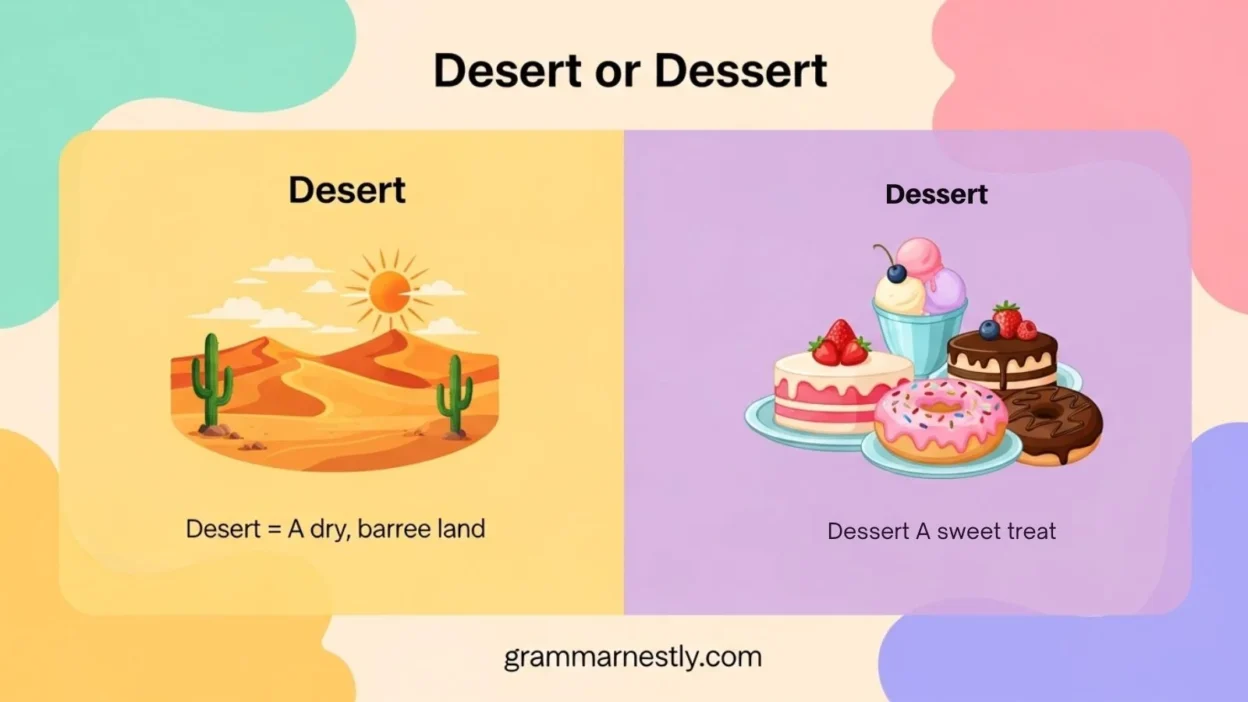
- Desert (dez-ert) → A dry, sandy place with little rain.
Example: The Sahara is the largest hot desert. - Dessert (dih-zurt) → A sweet dish eaten after meals.
Example: Chocolate cake is my favorite dessert.
Easy rule:
Dessert has two S’s because you always want “more sweets.”
The Origin of “Desert” and “Dessert”
- Desert comes from the Latin word desertus, meaning “left abandoned.” This later described land that is empty, dry, or barren.
- Dessert comes from the French word desservir, meaning “to clear the table.” It referred to the sweets served after clearing the main dishes.
The difference exists because the words came from different languages and meanings. Over time, English adopted both—but with separate spellings and pronunciations.
British English vs American English Spelling
Good news: Both British and American English spell “desert” and “dessert” the same way.
The difference is not the spelling—it is usage, pronunciation, and frequency.
Examples
| Variant | Meaning | UK Usage | US Usage |
|---|---|---|---|
| Desert | dry land | same | same |
| Dessert | sweet dish | same | same |
Where they differ:
- In the UK, “pudding” is often used instead of “dessert.”
- In the US, “dessert” is the standard word.
Which Spelling Should You Use?
- If writing for US readers: Use dessert for sweets and desert for dry land.
- If writing for UK/Commonwealth readers: Same spelling—but remember they may say pudding instead of dessert.
- For global readers: Stick to dessert (sweet) and desert (dry area). These forms are understood everywhere.
Common Mistakes with “Desert or Dessert”
- Using one “s” for sweets
- Wrong: I want a chocolate desert.
- Right: I want a chocolate dessert.
- Using two “s” for the dry land
- Wrong: Camels live in the dessert.
- Right: Camels live in the desert.
- Mixing up pronunciation
- Desert (place) = DEZ-ert
- Dessert (sweet) = dih-ZURT
- Confusing meanings in formal writing
Always check which meaning you need.
Desert or Dessert in Everyday Examples
Emails
- “Please bring a dessert to the office potluck.”
- “The team traveled across the desert for field research.”
News
- “Heat waves continue to rise in the desert regions.”
- “Local bakery wins award for best chocolate dessert.”
Social Media
- “Weekend mood: Coffee + my favorite dessert.”
- “Sunset in the Sahara desert is unreal!”
Formal Writing
- “Their journey through the desert lasted five days.”
- “The chef prepared a classic French dessert.”
Desert or Dessert – Google Trends & Usage Data
- “Dessert” is searched more often worldwide because people look for recipes, food photos, and menu ideas.
- “Desert” trends higher in countries with large dry regions (Middle East, Africa, US Southwest).
- In English-learning countries, searches spike for “desert or dessert” due to spelling confusion.
Usage Comparison Table
| Term | Meaning | Global Search Intent | Example |
|---|---|---|---|
| Desert | Dry land | Geography, climate | “Arabian Desert” |
| Dessert | Sweet food | Recipes, menus | “Best dessert ideas” |
FAQs
1. How do I remember the difference?
Dessert has two S’s because you want more sweets.
2. Are the words pronounced the same?
No.
- Desert (place) = DEZ-ert
- Dessert (sweet) = dih-ZURT
3. Do British people use the same spelling?
Yes. The spellings are identical worldwide.
4. Can “desert” mean something else?
Yes. As a verb, “to desert” means to abandon.
5. Is “desert” ever spelled with two S’s?
No. Only dessert has two S’s.
6. Is “pudding” the same as “dessert”?
In the UK, “pudding” often means dessert.
7. Which word is more common online?
“Dessert” is more searched because food content is popular.
Conclusion
Understanding the difference between desert and dessert is simple once you remember their meanings, spellings, and how they’re used in sentences.
Whether you’re writing an email, a blog, or social media caption, knowing when to use desert (dry land) and dessert (sweet treat) makes your writing clearer and more professional.
Now that you’ve mastered the keyword “desert or dessert”, you can confidently avoid this common mistake and help others do the same.

I’m Emma Collins, a grammar expert and author at Grammarnestly.com. I love helping readers master English with simple, practical grammar guides.
When I’m not writing, I enjoy reading, coffee, and exploring the beauty of language.