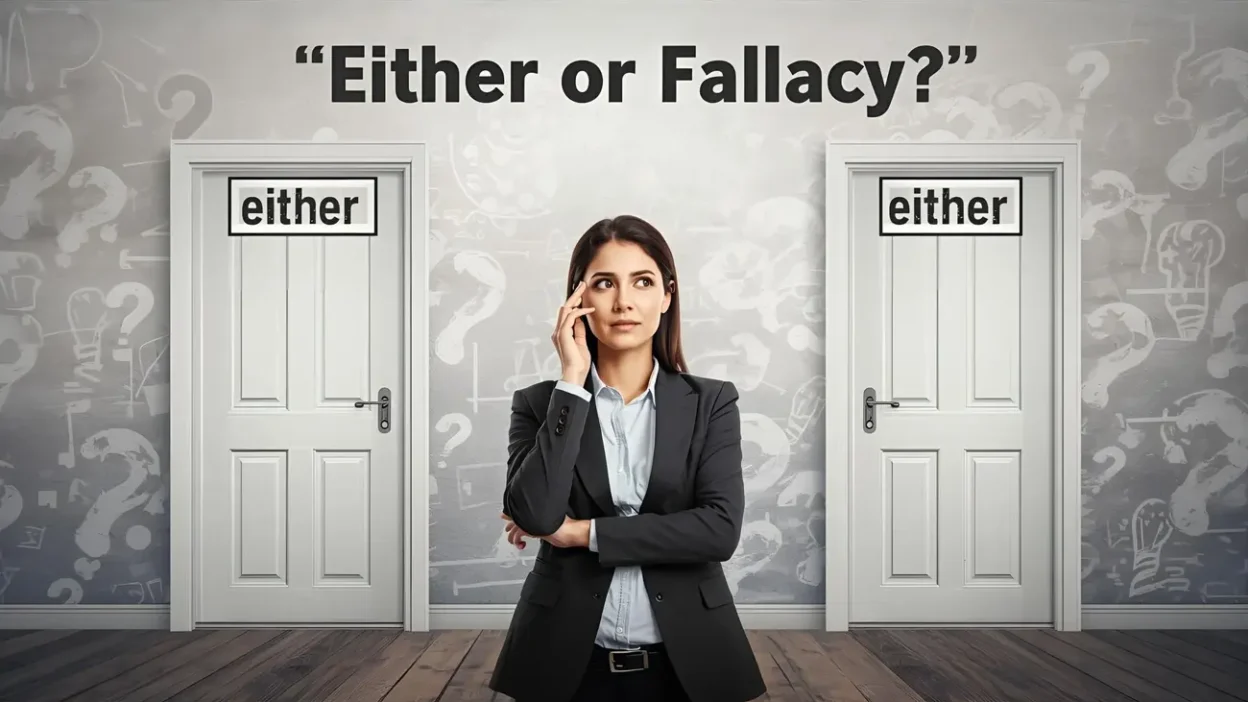
Have you ever felt stuck between just two choices, like it’s either success or failure? I’ve been there too!
The either or fallacy makes us think only two options exist when, in reality, life offers more. People search for this term because it’s common in debates, media, and daily talk—but rarely understood.
Let’s clear the confusion and learn how to spot and avoid this tricky reasoning trap. 🚀
Either or Fallacy – Quick Answer ✨
The either or fallacy (also called a false dilemma or false dichotomy) is a logical error where someone presents only two choices when more options actually exist.
Example:
- “You’re either with us or against us.”
- “Either you study law, or you’ll never be successful.”
In reality, there are often multiple possibilities, but the speaker oversimplifies the issue to persuade others.
The Origin of Either or Fallacy 📜
The phrase either or comes from Old English ægðer oððe, meaning “each of two.” The fallacy part originates from the Latin fallere, meaning “to deceive.”
Historically, philosophers like Aristotle discussed this reasoning flaw as a false dichotomy—a deceptive argument limiting the range of truth. Over time, it became a common term in logic, debate, and psychology to describe narrow or manipulative thinking.
British English vs American English Spelling 🇬🇧🇺🇸
Interestingly, the term either or fallacy doesn’t differ much between British and American English. However, pronunciation of “either” varies:
| Region | Pronunciation | Common Usage |
| British English | /ˈaɪðər/ | “Either or fallacy” used in logic and academics |
| American English | /ˈiːðər/ | “Either or fallacy” common in debates, politics, and media |
Both spellings are identical; only the sound and frequency in writing differ.
Which Spelling Should You Use? 🌍
You can use either or fallacy universally since spelling doesn’t change between regions.
- If you write for a US audience: prefer the American pronunciation “ee-thur.”
- If your readers are in the UK or Commonwealth: “eye-thur” pronunciation feels more natural.
- For global readers: just focus on explaining the meaning clearly—spelling stays the same.
Clarity always wins over regional differences.
Common Mistakes with Either or Fallacy ❌
Here are some frequent errors people make:
- Limiting choices too early – assuming only two sides exist.
- Ignoring nuance – forgetting that real situations often have multiple outcomes.
- Overusing the phrase – labeling every disagreement as an “either or fallacy.”
- Using emotionally loaded examples – to manipulate instead of reason logically.
✅ Correction Tip: Always check if more than two valid options exist before claiming an “either or” situation.
Either or Fallacy in Everyday Examples 💬
You’ll see this fallacy everywhere:
- Emails: Either you agree to this deal or the project fails.
- News headlines: You’re either pro-environment or anti-progress.
- Social media: Either you love pineapple pizza or you’re wrong.
- Formal writing: Either technology saves humanity or destroys it.
These examples show how simplifying complex topics can mislead readers and limit critical thinking.
Either or Fallacy – Google Trends & Usage Data 📊
According to Google Trends, searches for “either or fallacy” are highest in the United States, UK, India, and Philippines.
It spikes during election seasons, social debates, and academic exam periods—times when people seek to understand faulty arguments.
| Country | Interest Level | Common Context |
| United States | High | Political discussions |
| United Kingdom | Medium | Academic writing |
| India | Medium | Philosophy and logic exams |
| Philippines | Moderate | Social media debates |
The trend shows growing awareness about logical reasoning worldwide.
Comparison Table of Keyword Variations 📘
| Keyword Variation | Meaning | Usage Frequency |
| Either or fallacy | Common term for false dilemma | Very High |
| False dichotomy | Academic synonym | High |
| False dilemma | Formal term used in logic | Moderate |
| Black-and-white thinking | Psychological term | Growing |
FAQs About Either or Fallacy ❓
Q1: What is the either or fallacy in simple terms?
It’s when someone says there are only two options when more actually exist.
Q2: Is either or fallacy the same as false dichotomy?
Yes, both describe the same reasoning error with slightly different phrasing.
Q3: How can I avoid using this fallacy?
Always check for alternative explanations before deciding between two extremes.
Q4: Why do people use the either or fallacy?
It simplifies arguments and manipulates opinions—often unintentionally.
Q5: Can this fallacy appear in writing?
Yes, especially in persuasive essays, ads, and media headlines.
Q6: What’s an opposite of the either or fallacy?
Balanced reasoning that considers a spectrum of choices.
Q7: Is it ever okay to use “either or”?
Yes, grammatically it’s fine—but not when it falsely limits options.
Conclusion 🌈
The either or fallacy tricks us into thinking life is black and white when it’s full of color and choices. I encourage you to question arguments that box you into “this or that.” In debates, writing, or everyday talk—look for the missing middle ground.
Understanding this fallacy makes you a smarter thinker, stronger writer, and better communicator. Remember: wisdom lives in the “in-between,” not just in extremes. 🌿

Hi, I’m Jason Carter, the author behind GrammarNestly.com.
I’m a grammar expert with a passion for helping readers understand the English language in a simple and practical way.
I love breaking down confusing grammar rules and turning them into easy, everyday lessons that anyone can follow.