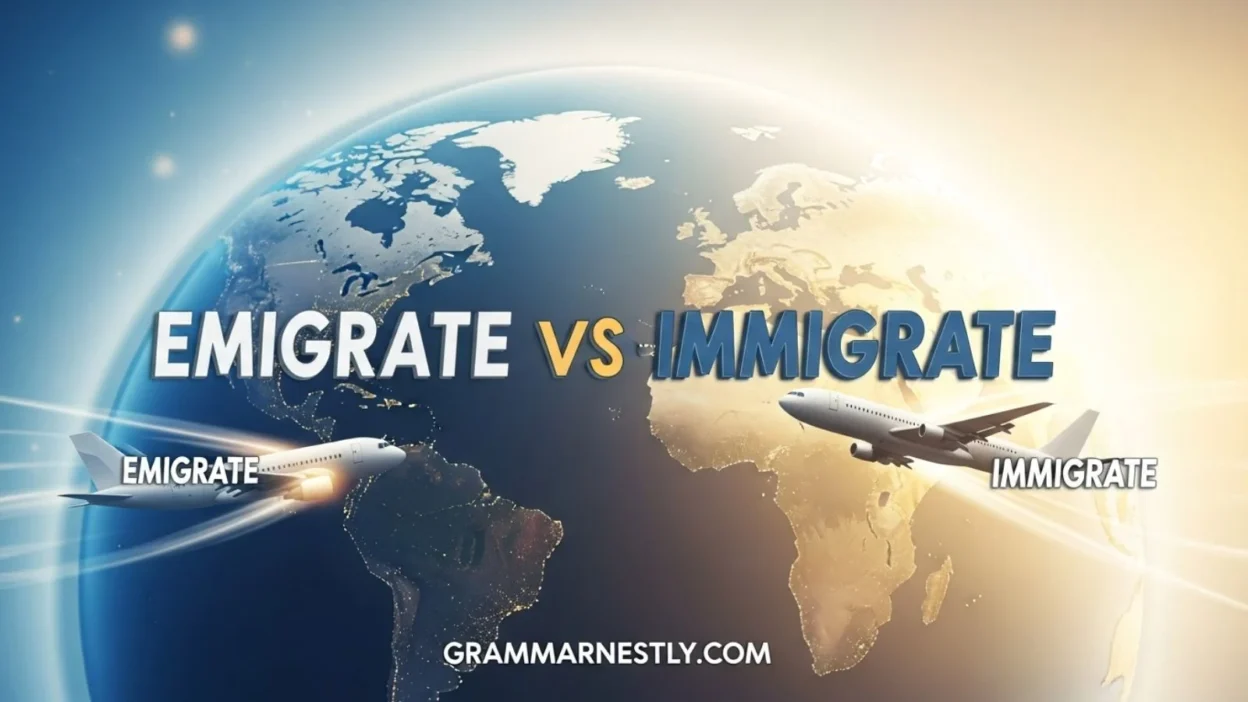
Confused about when to use emigrate or immigrate? You’re not alone — even native speakers mix them up all the time.
People search for “Emigrate vs Immigrate” to understand which word fits best when talking about leaving or entering a country. Getting it wrong can change the meaning completely.
This blog will clear the confusion and give you simple, practical rules. You’ll learn how to use each word correctly in emails, news, and formal writing.
By the end, you’ll confidently know the difference between emigrate and immigrate. Say goodbye to guesswork!
Emigrate vs Immigrate – Quick Answer
Quick Difference:
- Emigrate means to leave your country to live in another.
- Immigrate means to enter a new country to live permanently.
✅ Example:
- She emigrated from India in 2010. (She left India.)
- She immigrated to Canada in 2010. (She entered Canada.)
In short: You emigrate from somewhere and immigrate to somewhere.
The Origin of Emigrate vs Immigrate
Both words come from Latin roots:
- Emigrate derives from emigrare — “to move out.”
- Immigrate comes from immigrare — “to move in.”
Their prefixes are key:
- E- (ex-) = out of
- Im- (in-) = into
That’s why “emigrate” focuses on leaving a place, while “immigrate” focuses on arriving somewhere new. The confusion comes from their similar endings and shared topic — relocation.
British English vs American English Spelling
There’s no spelling difference between “emigrate” and “immigrate” in British or American English. However, there may be a difference in usage preference.
| Word | Meaning | UK Usage Example | US Usage Example |
|---|---|---|---|
| Emigrate | Leave one’s country | They emigrated from Ireland in the 1950s. | My grandparents emigrated from Poland. |
| Immigrate | Enter another country | She immigrated to Britain last year. | They immigrated to the U.S. for work. |
British writers often discuss emigration in historical or colonial contexts, while Americans more often discuss immigration due to their country’s cultural mix.
Which Spelling Should You Use?
Use both correctly based on perspective:
- When talking about leaving your home country → Emigrate
- When talking about arriving in a new country → Immigrate
📍 Audience-based tip:
- US writers: “Immigrate” appears more often in policy and news.
- UK/Commonwealth writers: “Emigrate” is common when discussing people moving abroad.
- Global writing: Use both — but define them clearly for clarity.
Common Mistakes with Emigrate vs Immigrate
| Incorrect Sentence | Correct Sentence | Explanation |
|---|---|---|
| He immigrated from France last year. | He emigrated from France last year. | He left France → emigrate. |
| She emigrated to the U.S. | She immigrated to the U.S. | She entered the U.S. → immigrate. |
| Our family emigrated America. | Our family emigrated from America. | Must use from after emigrate. |
| They immigrated from Spain. | They immigrated to Spain. | Must use to after immigrate. |
Emigrate vs Immigrate in Everyday Examples
In Emails:
“After I emigrate from Australia, I’ll need help with immigration paperwork in Canada.”
In News Headlines:
“More people emigrate from the UK post-Brexit.”
“Thousands immigrate to the U.S. annually for better opportunities.”
In Social Media:
“Can’t believe it’s been five years since I immigrated to Canada! 🇨🇦”
In Formal Writing:
“Economic instability has caused many citizens to emigrate in search of better prospects.”
Emigrate vs Immigrate – Google Trends & Usage Data
Recent Google Trends data shows:
- “Immigrate” is more searched in the United States, Canada, and Australia.
- “Emigrate” trends higher in the UK, Ireland, and South Africa.
| Country | More Common Word | Reason |
|---|---|---|
| USA | Immigrate | Immigration laws & news coverage |
| UK | Emigrate | More outbound migration focus |
| Canada | Immigrate | Popular destination for newcomers |
| Australia | Emigrate / Immigrate (balanced) | Both incoming and outgoing migration |
| India | Emigrate | Many leave for overseas work or study |
FAQs – Emigrate vs Immigrate
1. What is the main difference between emigrate and immigrate?
“Emigrate” means to leave your country; “immigrate” means to enter a new one.
2. Can I use both in the same sentence?
Yes! “She emigrated from India and immigrated to Canada in 2010.”
3. Which comes first — emigration or immigration?
You emigrate first (leave) and immigrate after (arrive).
4. Are the nouns different too?
Yes — emigration (act of leaving) and immigration (act of entering).
5. What about “migrate”?
“Migrate” is general — it can mean moving within a country or between countries.
6. Is “immigrate” used with ‘to’ and “emigrate” with ‘from’?
Exactly! Always immigrate to and emigrate from.
7. Which is more formal?
Both are formal; it depends on context, not tone.
Conclusion
“Emigrate vs Immigrate” is all about direction — whether someone is leaving or entering a country. Remember: E for Exit (emigrate), I for Into (immigrate). Once you master that trick, you’ll never misuse them again.
Both British and American English use the same spelling, so the real key is understanding perspective. Use emigrate when focusing on departure, and immigrate when focusing on arrival.
Clear writing means clear direction — so next time you describe someone’s move abroad, pick the right word confidently.

Hi, I’m Ernest Hemingway, the author of GrammarNestly.com.
I’m a grammar expert and language enthusiast who loves making English simple and practical.
When I’m not writing about grammar, I enjoy reading, exploring new writing styles, and helping others improve their communication skills.