Do you ever pause before writing every day or everyday? You are not alone—many people struggle to choose the right one.
The confusion comes from similar spelling but different meanings. Every day refers to time, while everyday is an adjective describing routine or common things.
This blog will clear it all up. You will learn the difference, correct usage, and simple tips to remember them.
By the end, you’ll confidently use every day or everyday in emails, essays, and professional writing. It’s easy, clear, and practical.
Every Day or Everyday – Quick Answer
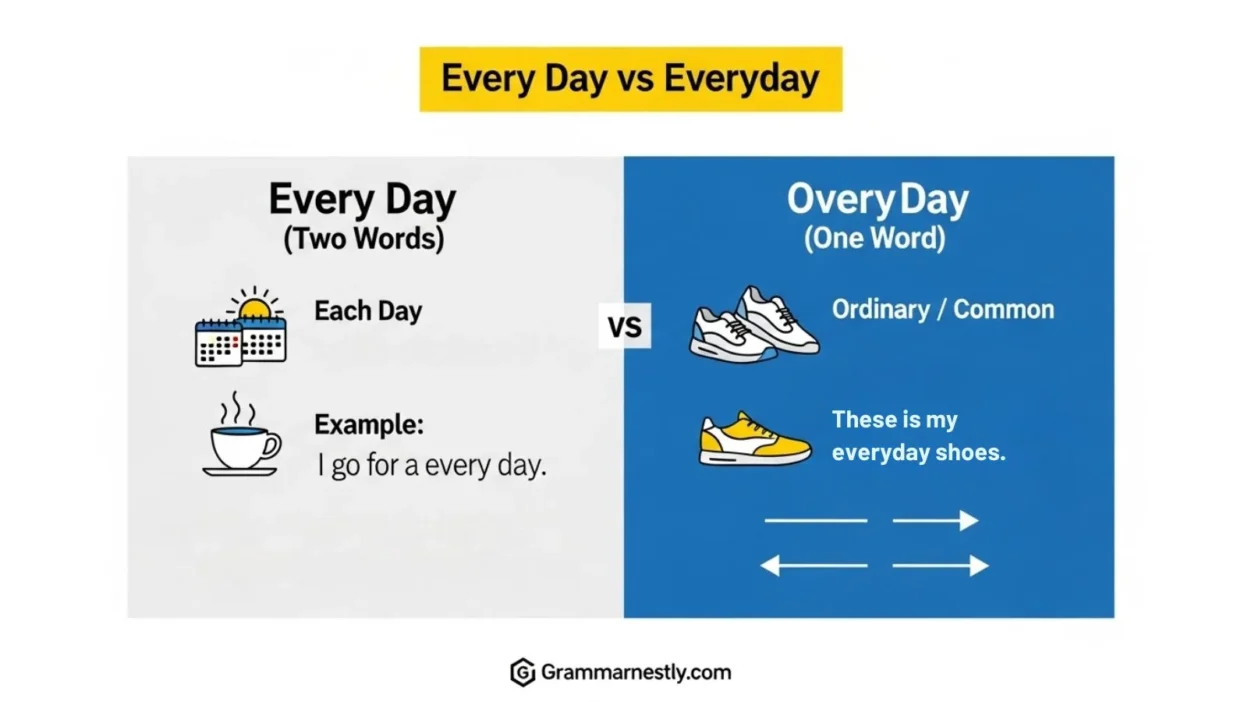
- Every day = each day. Example: I go for a walk every day.
- Everyday = ordinary or common. Example: These are my everyday shoes.
Tip: If you can replace it with “each day,” use every day. If you’re describing something normal, use everyday.
The Origin of Every Day or Everyday
The confusion comes from English evolving over centuries. Every day has always been a two-word phrase meaning “each day.” Over time, everyday emerged as a single adjective to describe things that are ordinary or routine. Dictionaries formalized this distinction in the 19th and 20th centuries.
British English vs American English Spelling
Both British and American English follow the same rules for every day vs everyday, but spelling preferences differ slightly in certain adjectives.
| Form | Meaning | Example (UK) | Example (US) |
|---|---|---|---|
| Every day | Each day | I walk to work every day. | I walk to work every day. |
| Everyday | Ordinary, common | Everyday life is busy. | Everyday life is busy. |
Note: There’s no major difference in this case; both forms are used similarly in UK and US English.
Which Spelling Should You Use?
- US Writers: Follow the “quick answer” rule. Every day for “each day,” everyday for “ordinary.”
- UK/Commonwealth Writers: Same rule applies; no regional differences.
- Global Audience: Stick to the rule for clarity. Misusing these forms can confuse readers.
Common Mistakes with Every Day or Everyday
- Wrong: I wear my shoes every day shoes.
Right: I wear my everyday shoes. - Wrong: Everyday I go to the gym.
Right: Every day I go to the gym. - Wrong: This is an every day task.
Right: This is an everyday task.
Tip: Replace with “each day” to test if “every day” is correct.
Every Day or Everyday in Everyday Examples
- Emails: Please check your inbox every day for updates.
- News: Everyday challenges make heroes stronger.
- Social Media: Trying to drink water every day!
- Formal Writing: Maintaining an everyday routine improves productivity.
Every Day or Everyday – Google Trends & Usage Data
Search trends show that “every day” is more commonly searched than “everyday”, especially in educational queries. Top countries: US, UK, Canada, and India. Most searches are to clarify correct usage in writing, social media, or school assignments.
Comparison Table
| Form | Type | Meaning | Replaceable With “Each Day”? |
|---|---|---|---|
| Every day | Phrase | Each day | ✅ Yes |
| Everyday | Adjective | Ordinary/Common | ❌ No |
FAQs
1. Can I use everyday as two words?
No, “everyday” is always one word when used as an adjective.
2. Is every day always two words?
Yes, when you mean “each day,” it’s two separate words.
3. How do I remember the difference?
Replace with “each day.” If it fits, use every day. Otherwise, use everyday.
4. Are there regional differences?
No significant differences; both UK and US English follow the same rule.
5. Can everyday be used in formal writing?
Yes, when describing routine or ordinary objects or tasks.
6. Is every day common in casual writing?
Yes, especially in emails, social media, and instructions.
7. Can I start a sentence with every day?
Yes, for example: Every day brings a new opportunity.
Conclusion
Understanding every day vs everyday is simple once you know the difference. Every day refers to something happening each day, while everyday describes something ordinary or routine.
Misusing them can confuse readers, but a simple “each day” test makes it easy to choose the correct form.
Both UK and US English follow the same rules, so writers worldwide can apply this knowledge confidently.
Whether you’re writing emails, social media posts, or formal papers, using the right form will make your writing clear and professional.

Hi, I’m Ernest Hemingway, the author of GrammarNestly.com.
I’m a grammar expert and language enthusiast who loves making English simple and practical.
When I’m not writing about grammar, I enjoy reading, exploring new writing styles, and helping others improve their communication skills.