Have you ever typed “freshmen or freshman” and stopped, unsure which one to use? I know that feeling—I’ve made the same mistake myself.
If you’re a student, teacher, blogger, or just someone who wants to polish their English, this guide is written with you in mind.
It’s easy to get confused when two words look almost the same but mean different things.
Don’t worry, I’ve got you covered. In this article, I’ll explain the difference clearly and simply so you’ll always know the right choice. Let’s sort this out together!
Freshmen or Freshman – Quick Answer
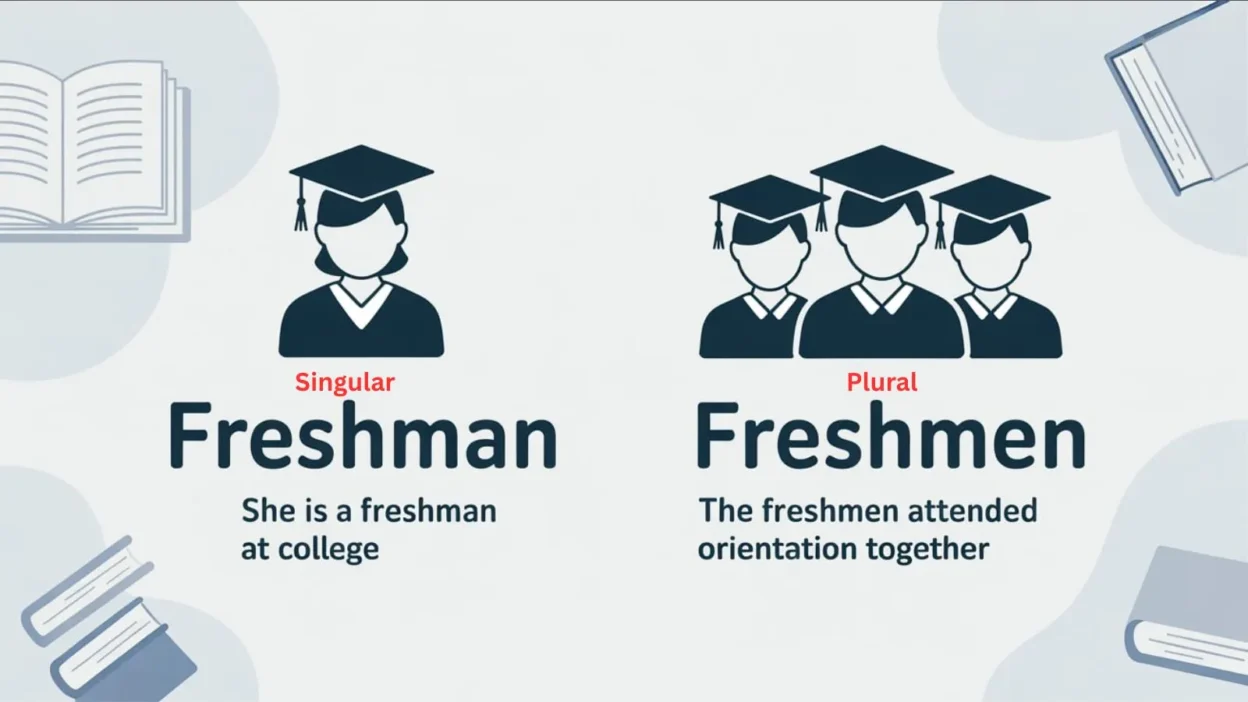
- Freshman = singular (one first-year student).
- Example: She is a freshman at Harvard.
- Example: She is a freshman at Harvard.
- Freshmen = plural (two or more first-year students).
- Example: The freshmen attended orientation together.
- Example: The freshmen attended orientation together.
👉 Think of it like man → men. One student = freshman. Many students = freshmen.
The Origin of Freshmen or Freshman
The word freshman comes from Middle English (around the 16th century). It was formed from “fresh” (new) and “man” (person). Originally, it meant a beginner or novice in any field, not just school. Over time, it became strongly linked to education, especially in the U.S.
The plural form freshmen follows the same pattern as man → men. That’s why the vowel changes instead of just adding “s.”
British English vs American English Spelling
Interestingly, both British and American English use freshman (singular) and freshmen (plural). The difference lies more in how often the word is used.
- In the U.S., “freshman” is the standard word for a first-year student.
- In the U.K., people more often say “first-year student,” though “freshman” is still understood.
Comparison Table
| Form | Meaning | Example (US) | Example (UK) |
| Freshman | Singular (1 student) | He’s a freshman at Yale. | She’s a first-year (freshman). |
| Freshmen | Plural (2+ students) | The freshmen had a welcome party. | The first-years (freshmen) met. |
Which Spelling Should You Use?
- If writing for a U.S. audience → Use freshman (singular) and freshmen (plural).
- If writing for a U.K. or Commonwealth audience → Prefer “first-year student(s),” but freshman/freshmen are still correct.
- For global audiences → Use “first-year student” if you want clarity.
Common Mistakes with Freshmen or Freshman
- Using freshmen for one student.
- Wrong: He is a freshmen.
- Correct: He is a freshman.
- Wrong: He is a freshmen.
- Adding “s” after freshmen.
- Wrong: Freshmens are here.
- Correct: Freshmen are here.
- Wrong: Freshmens are here.
- Mixing tenses.
- Wrong: She will be a freshmen next year.
- Correct: She will be a freshman next year.
- Wrong: She will be a freshmen next year.
Freshmen or Freshman in Everyday Examples
- Email: Welcome, freshman class of 2025!
- News headline: Freshmen enrollment rises 10% this year.
- Social media post: Can’t believe I’m already a college freshman!
- Formal writing: The freshmen participated in orientation programs.
Freshmen or Freshman – Google Trends & Usage Data
Data shows that “freshman” is searched more often in the U.S., while “freshmen” appears more in group or class contexts.
Keyword Comparison Table
| Keyword | Popularity (US) | Popularity (UK) | Context of Use |
| Freshman | Very high | Moderate | Refers to one student |
| Freshmen | High | Low | Refers to many students |
| First-year | Low | High | Formal UK/academic usage |
FAQs About Freshmen vs Freshman
1. Is freshman singular or plural?
Freshman = singular. Freshmen = plural.
2. Can I say “a freshmen”?
No. Use a freshman (singular).
3. Do British people use freshman?
Yes, but less often. They usually say first-year student.
4. Is freshmen correct in formal writing?
Yes, if you mean more than one student.
5. Can freshman mean “class of students”?
Yes. Example: The freshman class will graduate in 2028.
6. Why does freshmen change the vowel?
It follows the same rule as man → men.
7. Which is more common in search engines?
“Freshman” is searched more, but both appear often.
Conclusion
The confusion between freshmen and freshman is common but easy to solve. Remember: freshman is for one student, freshmen is for many.
Both forms are correct in American and British English, but their frequency differs. Americans use them daily, while British speakers lean toward “first-year student.”
When writing, think of your audience. If you’re addressing Americans, stick with freshman/freshmen. For British or global readers, “first-year” may be clearer. Avoid common mistakes like saying a freshmen or freshmens.
In short: Freshman = one, Freshmen = many. Use them confidently in essays, emails, and conversations. With this simple rule, you’ll never mix them up again.

Hi, I’m Jason Carter, the author behind GrammarNestly.com.
I’m a grammar expert with a passion for helping readers understand the English language in a simple and practical way.
I love breaking down confusing grammar rules and turning them into easy, everyday lessons that anyone can follow.