Choosing between further or farther can feel confusing, even for skilled writers. The words look similar, sound alike, and seem to mean the same thing.
Many people search this keyword because they want a simple rule they can trust. They want to avoid mistakes in emails, exams, and professional writing.
This guide gives you a clear answer you can remember in seconds. You’ll learn when to use each word with easy examples and quick tips.
By the end, you’ll know exactly which form fits your sentence. And you’ll write with confidence every time.
Further or Farther – Quick Answer
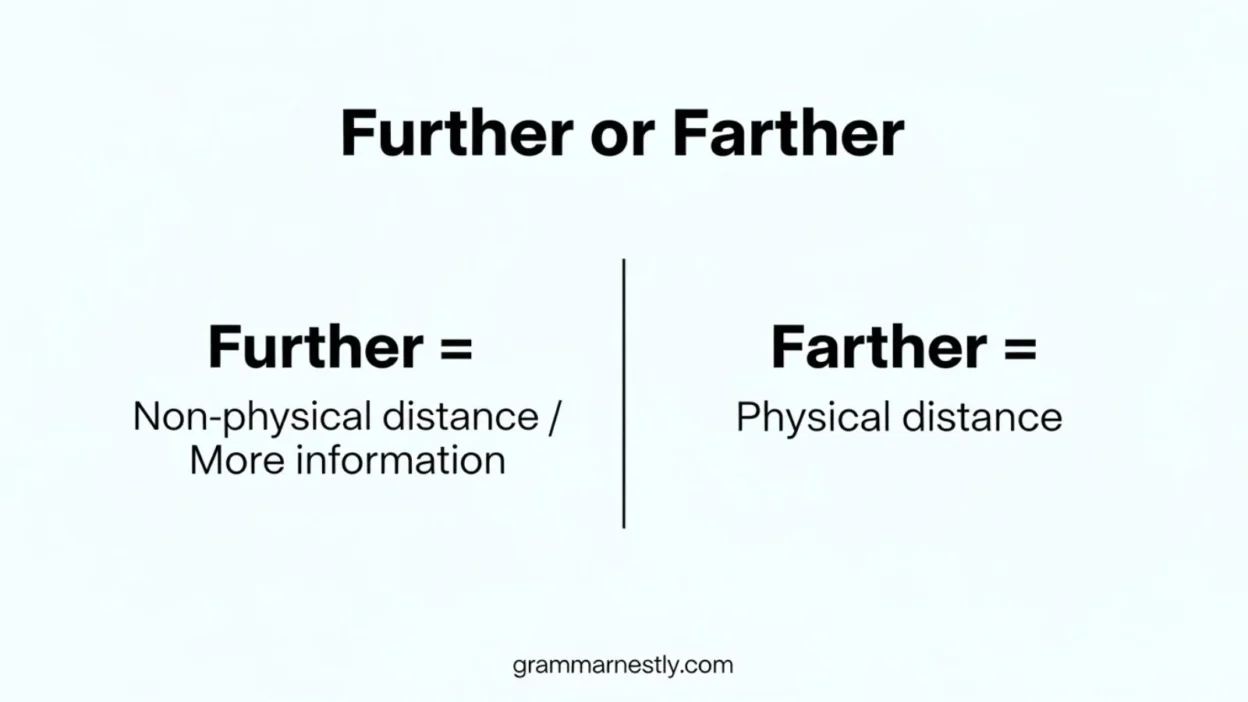
Use farther for physical distance.
Use further for non-physical distance or “more.”
Examples:
- We walked farther than yesterday. (physical distance)
- Let’s discuss this further. (non-physical, meaning “more”)
- The store is farther down the road.
- I need further information.
The Origin of “Further” and “Farther”
Both words come from Old English.
- Further comes from furthera, meaning “more advanced” or “additional.”
- Farther developed from feorr, meaning “far.”
For centuries, both words were used for distance. Only in the 19th–20th centuries did grammarians begin separating them into physical vs. figurative distance. This is why they still overlap today—but the modern rule is widely accepted.
British English vs American English Spelling
The spelling is the same in both dialects, but the rules differ slightly.
- American English makes a stronger distinction:
- Farther = physical distance
- Further = figurative distance or “more”
- British English allows further for almost everything, even physical distance.
Comparison Table
| Aspect | American English | British English |
|---|---|---|
| Physical distance | Farther | Further or Farther |
| Figurative distance | Further | Further |
| “More” or “additional” | Further | Further |
| Most common in daily use | Further | Further |
Which Spelling Should You Use?
If you write for a US audience:
Follow the strict rule. Use farther for physical distance and further for everything else.
If you write for UK/Commonwealth readers:
Further is safe in almost all cases.
If your audience is global:
Use further unless the context clearly shows physical distance.
Common Mistakes with “Further or Farther”
❌ Wrong: We need farther details.
✔ Correct: We need further details.
❌ Wrong: Let’s discuss this farther.
✔ Correct: Let’s discuss this further.
❌ Wrong: The office is further down the road (in American English)
✔ Correct: The office is farther down the road.
“Further or Farther” in Everyday Examples
Emails
- Please send any further questions by Friday.
- The site is farther from our main office.
News
- The investigation will continue further next week.
- Rescue teams traveled farther into the mountains.
Social Media
- Any further updates coming soon?
- How much farther to the campsite?
Formal Writing
- No further evidence was presented.
- The team moved farther into the restricted zone.
Further or Farther – Google Trends & Usage Data
Search data shows:
- “Further” is used far more often worldwide.
- British English regions (UK, India, Pakistan, Australia, South Africa) heavily prefer “further” for nearly all meanings.
- The US shows clearer interest in the rule distinction and searches “further vs farther” more frequently.
- “Further” also dominates in academic writing, reports, and news articles.
This trend confirms that further is the safer, more universal choice.
Comparison Table: Further vs Farther
| Word | Meaning | Usage | Example |
|---|---|---|---|
| Further | More, additional, figurative distance | Most situations; safest choice | Please provide further details. |
| Farther | Physical distance | Movement, travel, space | He ran farther than last time. |
FAQs
1. Is “further” always correct?
Yes, in most cases. Especially in British English and global writing.
2. Can I use “farther” for figurative distance?
In modern English, no. Use further.
3. Do Americans still use “farther”?
Yes, mainly for physical distance.
4. Which is more common internationally?
Further is far more common worldwide.
5. Is “furthermore” related?
Yes. It comes from the same root and means “in addition.”
6. Can I use “further” in academic writing?
Absolutely. It is the preferred form for non-physical meaning.
7. Are the words interchangeable?
Sometimes, but further is usually the safer choice.
Conclusion
Choosing between further and farther is simple. Use farther for physical distance and further for everything else, including progress and extra information.
While both words once meant the same thing, modern English—especially in the US—now separates them.
For British or global readers, further works in almost every situation. For American audiences, the physical vs. non-physical rule keeps your writing clear and correct.
Clarity matters. Choosing the right word makes your writing smooth and professional.
When unsure, choose further—it’s almost always the safest option. You now have the key rules and examples to use both words correctly.

I’m Emma Collins, a grammar expert and author at Grammarnestly.com. I love helping readers master English with simple, practical grammar guides.
When I’m not writing, I enjoy reading, coffee, and exploring the beauty of language.