If you’ve ever typed a quick message and paused, wondering whether to write goodmorning or good morning, you’re not alone.
Millions of people search this phrase every month, trying to figure out the correct spelling. The confusion comes from how often we see the word online—sometimes as one word, sometimes as two.
Because greetings are used daily in texts, emails, and even professional settings, it’s important to know the correct form. This guide explains the right spelling, why the mistake happens, and how usage differs across English varieties.
By the end, you’ll know when and how to use good morning correctly without second-guessing yourself.
Goodmorning or Good Morning – Quick Answer
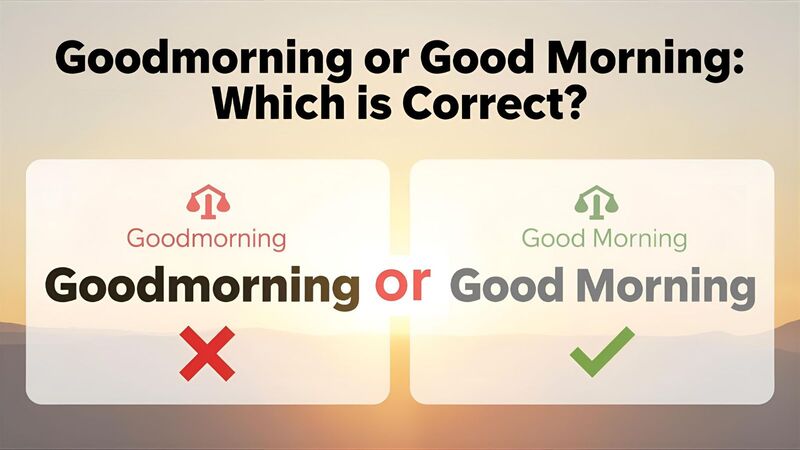
The correct spelling is “good morning” (two words).
- ✅ Correct: Good morning, Sarah!
- ❌ Incorrect: Goodmorning, Sarah!
The phrase combines the adjective good with the noun morning. Together, they form a greeting, not a single compound word.
The Origin of Good Morning
The greeting good morning dates back to the 14th century. At that time, people used it as a polite way to wish someone well at the start of the day. Over time, it became a standard expression in English.
Unlike words that merged into compounds (like goodnight), good morning stayed separate because morning is a time of day, not an action. This is why the spelling difference exists today.
British English vs American English Spelling
Both British and American English agree: the correct form is good morning (two words). However, English does have many differences in spelling (e.g., colour vs color, favour vs favor).
| Example Word | British English | American English |
| Greeting | Good morning | Good morning |
| Colour/Color | Colour | Color |
| Favourite | Favourite | Favorite |
| Organise/Organize | Organise | Organize |
Unlike some words that differ between regions, good morning is consistent across English varieties.
Which Spelling Should You Use?
Always use “good morning” (two words).
- If writing for a US audience → Use good morning.
- If writing for a UK/Commonwealth audience → Use good morning.
- If writing for a global audience → Use good morning.
There is no context where goodmorning is considered correct spelling.
Common Mistakes with Good Morning
- Writing goodmorning as one word.
- Forgetting capitalization in formal writing (Good morning vs good Morning).
- Using it in the wrong time of day (don’t say good morning at night).
- Mixing it with goodnight (which is correct as one word).
Good Morning in Everyday Examples
- Email: Good morning, team. Let’s review today’s tasks.
- News: The mayor greeted citizens with a cheerful “Good morning” during the event.
- Social Media: Good morning, everyone ☀️ Hope you have a great day!
- Formal Writing: He began his speech with a simple, polite “Good morning.”
Good Morning – Google Trends & Usage Data
Search data shows that good morning (two words) is used overwhelmingly more than goodmorning. Google Trends indicates high popularity in the US, UK, India, and Nigeria—countries where English is widely spoken.
The single-word spelling goodmorning appears mostly in informal posts or typos, not in formal sources.
| Variation | Correctness | Usage Level |
| Good morning | ✅ Correct | Very High |
| Goodmorning | ❌ Incorrect | Low/Informal |
Conclusion
When choosing between goodmorning and good morning, the answer is simple: always write it as two words. This form has been correct since Middle English times and remains the standard in both British and American English.
While the single-word version shows up in casual posts, it is not accepted in professional or academic writing. To avoid mistakes, remember that greetings like good morning, good afternoon, and good evening are two words, while farewells like goodnight are often one word.
Knowing the difference helps you write clearly, professionally, and with confidence, whether in emails, formal documents, or friendly chats.
FAQs:
1. Is “goodmorning” ever correct?
No, the correct spelling is always good morning.
2. Why is “goodnight” one word but “good morning” two words?
Because goodnight evolved as a farewell phrase, while good morning stayed as a greeting phrase.
3. Should I capitalize “Good morning” in emails?
Capitalize the first word (Good) but not morning unless it starts a sentence.
4. Do British and American English differ in this spelling?
No, both use good morning.
5. Can I use “good morning” in professional emails?
Yes, it’s a polite and widely accepted greeting.
6. What’s the abbreviation for “good morning”?
On social media, people use GM as shorthand.
7. Is it okay to write “Good Morning” with both words capitalized?
Only if it’s a title or heading. Otherwise, write Good morning.