Have you ever typed in route and paused, wondering if it’s correct? Many writers, students, and professionals get confused between in route or en route.
The two phrases sound the same but have very different meanings. Knowing which one to use can make your emails, reports, and posts look polished.
If you’re unsure about spelling or want to write confidently, this guide explains in route or en route clearly.
By the end, you’ll know the correct usage every time.
In Route or En Route – Quick Answer
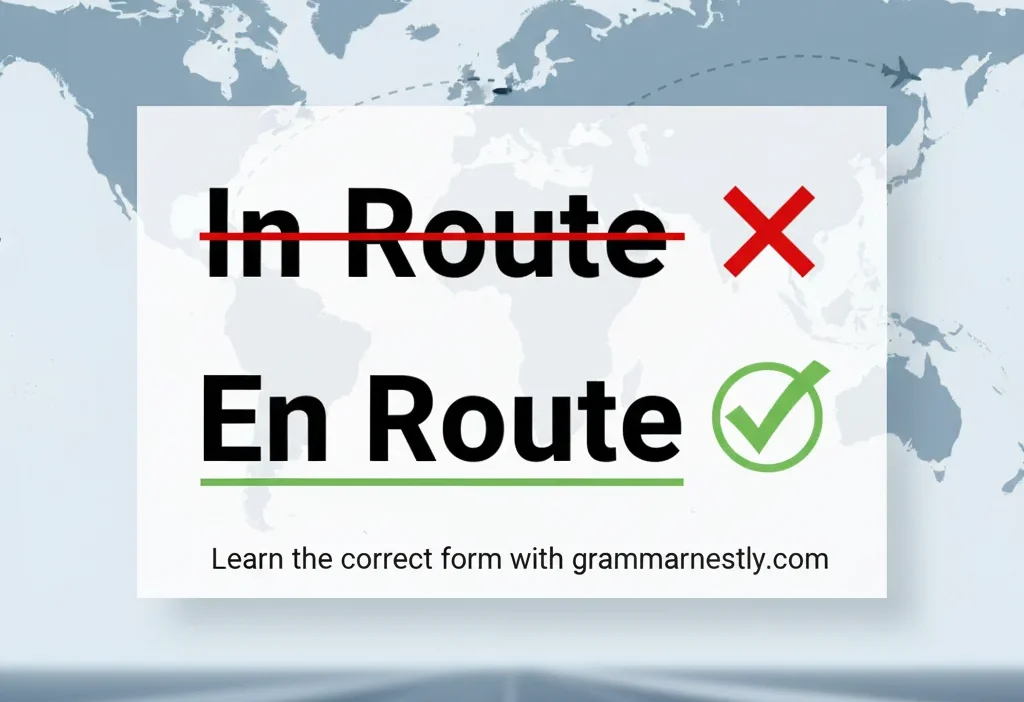
✅ Correct: En route
❌ Incorrect: In route
Meaning: En route means “on the way” or “in transit.”
Examples:
- The package is en route to your address.
- She’s en route to the airport.
🚫 Don’t write in route — it’s a common misspelling caused by the similar sound.
Quick Rule:
Always use “en route” when you mean on the way or in progress toward a destination.
The Origin of “In Route” and “En Route”
The phrase “en route” comes from French, where en means “in” or “on” and route means “road” or “way,” so it literally means “on the way.”
It entered English in the 18th century, keeping its French spelling and pronunciation (on root).
“In route” appeared later as a phonetic error, but it makes no grammatical sense.
👉 Bottom line: En route is correct; in route is a mistaken imitation.
British English vs American English Spelling
Interestingly, both British and American English use “en route” with the same spelling.
However, Americans are more likely to use it in everyday writing (emails, updates, texts), while Brits tend to use it in more formal contexts.
Here’s a quick comparison:
| Region | Correct Spelling | Example | Notes |
|---|---|---|---|
| 🇺🇸 American English | En route | “The delivery driver is en route to your home.” | Common in casual and professional writing. |
| 🇬🇧 British English | En route | “The prime minister is en route to Brussels.” | Used mainly in formal or journalistic English. |
| 🌍 Common Mistake (All Regions) | In route | “I’m in route to work.” | ❌ Incorrect — never use this spelling. |
Note: You may sometimes see “on route” in British writing — it’s more acceptable there, but en route is still preferred worldwide.
Which Spelling Should You Use?
Here’s how to decide which version fits your audience:
- If you write for American readers:
Always use “en route.” It’s clear, correct, and familiar. - If you write for British or Commonwealth readers:
You can also use “en route.” “On route” may appear locally, but “en route” remains more standard. - If you write for an international or online audience:
✅ “En route” is universally recognized — it works best everywhere.
Pro tip: Avoid “in route” altogether. Spellcheckers and editors will flag it as an error.
Common Mistakes with “In Route” or “En Route”
Here are some frequent mix-ups and how to fix them 👇
| ❌ Incorrect | ✅ Correct | Why |
|---|---|---|
| The driver is in route to your house. | The driver is en route to your house. | “In route” is grammatically incorrect. |
| I’ll be in route in 10 minutes. | I’ll be en route in 10 minutes. | “En route” means “on the way.” |
| She’s in route to the meeting now. | She’s en route to the meeting now. | “En” is the French preposition meaning “on.” |
| Your order is in route for delivery. | Your order is en route for delivery. | Correct global English usage. |
👉 Remember: “En route” = on the way.
“In route” = ❌ not a valid expression in English.
“In Route” or “En Route” in Everyday Examples
Here’s how you’ll see en route used in real life across different contexts 👇
| Context | Example Sentence | Form Used | Region |
|---|---|---|---|
| 📰 News | “Emergency crews are en route to the scene.” | En route | Global |
| 💼 Business Email | “Your shipment is en route and will arrive by tomorrow.” | En route | US/UK |
| ✈️ Travel Update | “We’re currently en route to Paris.” | En route | Global |
| 📱 Text Message | “Running late — I’m en route now!” | En route | Global |
| 🎓 Academic Writing | “The research team is en route to conduct fieldwork.” | En route | Formal English |
| ⚠️ Common Error | “I’m in route to the airport.” | ❌ In route | Common Mistake |
“In Route” or “En Route” – Google Trends & Usage Data
Let’s look at what the data says 👇
| Word/Phrase | Global Popularity | Correctness | Common Context |
|---|---|---|---|
| En route | 🌍 Very high | ✅ Correct | News, travel, delivery, text updates |
| In route | ⚠️ Moderate (incorrect use) | ❌ Incorrect | Casual speech, typos, online posts |
| On route | 🇬🇧 Moderate | ⚠️ Acceptable (UK only) | British informal writing |
Google Trends Insight:
- En route dominates worldwide searches — especially in the US, UK, Canada, and Australia.
- In route still appears frequently in American casual texts and posts but is almost always marked as a spelling mistake.
Conclusion:
If you want your writing to sound polished and professional, always go with en route.
FAQs about “In Route” vs “En Route”
1. Is “in route” ever correct?
No. “In route” is a misspelling of “en route,” which means “on the way.”
2. What does “en route” mean?
It means “on the way” or “in transit.” Example: “Your order is en route.”
3. How do you pronounce “en route”?
It’s pronounced on root (from the French origin).
4. Is “on route” the same as “en route”?
In British English, “on route” is sometimes used, but “en route” is still the standard form.
5. Can I write “enroute” as one word?
Not in formal writing. It’s sometimes seen online, but the correct form is two words: en route.
6. Is “en route” formal or informal?
It’s neutral — suitable for both formal and casual writing.
7. What’s a synonym for “en route”?
“On the way,” “in transit,” or “heading to.”
Conclusion
The debate between in route and en route is simple — only one is correct.
Use en route whenever you mean “on the way” or “in transit.” It’s the correct form in both American and British English, and it fits all writing styles — from emails to academic papers.
Avoid in route, as it’s always marked incorrect. And while on route can appear in British texts, en route remains the globally accepted standard.
Next time you’re updating your status or writing a message, remember:
You’re always en route, never in route.