Many English writers struggle with “its” vs “it’s”. These two forms may sound the same, but their meanings and usage are very different. Confusing them can make your writing look unprofessional or unclear.
People often search for “its or it’s” to quickly clarify which form is correct, especially in emails, school assignments, social media posts, and formal writing.
This guide will give you a clear answer, explain the history, and provide examples for daily usage. By the end, you will confidently know which one to use and avoid common mistakes.
Its or It’s – Quick Answer
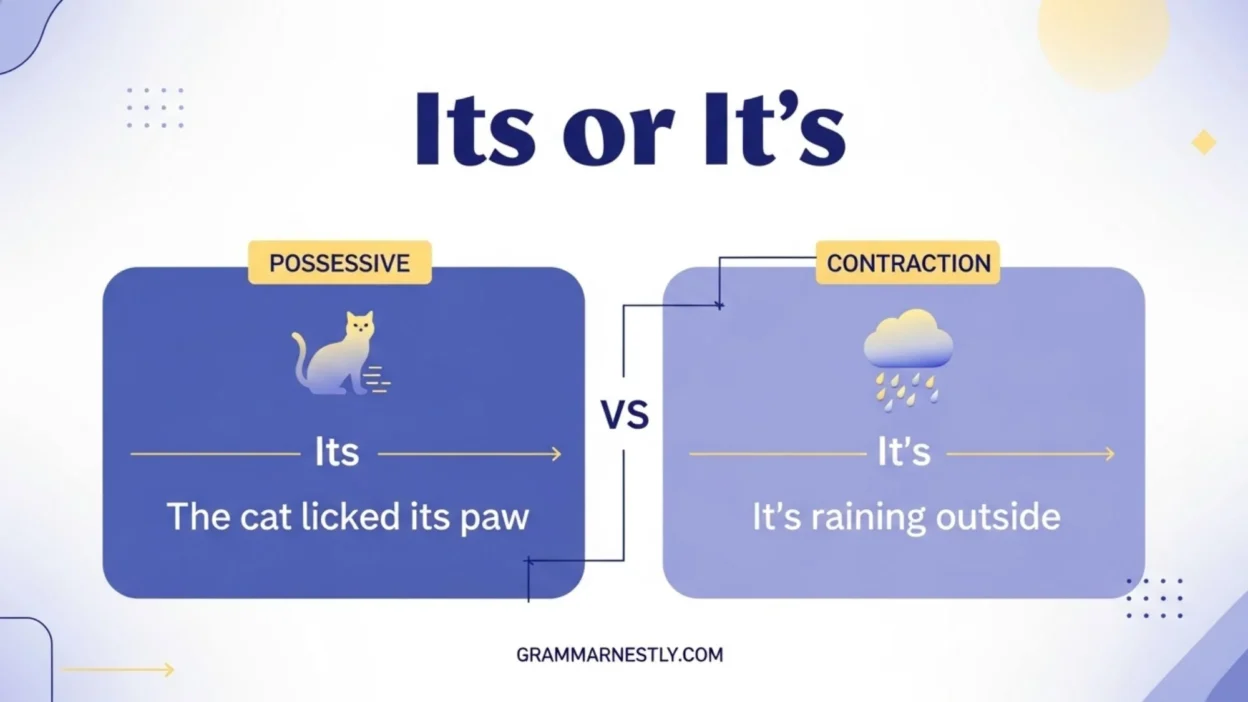
- Its → Possessive form of “it.” Shows ownership.
Example: The cat licked its paw. - It’s → Contraction of “it is” or “it has.”
Example: It’s raining outside. (It is raining)
Example: It’s been a long day. (It has been)
Quick Tip: If you can replace it with “it is” or “it has,” use it’s. Otherwise, use its.
The Origin of Its or It’s
The word “its” without an apostrophe emerged in the 17th century to represent possession. Before that, writers often used “his” or “her” for inanimate objects, which was confusing.
“It’s”, as a contraction of “it is” or “it has,” has been in use since the 16th century. The apostrophe in it’s signals the missing letters, a common feature in English contractions.
British English vs American English Spelling
Both British and American English follow the same rule for its vs it’s. The difference lies more in style guides rather than spelling. Some older British texts occasionally used it’s for possession, but modern English universally reserves its for possession.
Comparison Table:
| Form | Meaning | Example | UK Usage | US Usage |
|---|---|---|---|---|
| its | Possessive | The company changed its policy. | ✔ | ✔ |
| it’s | Contraction | It’s going to snow tomorrow. | ✔ | ✔ |
Which Spelling Should You Use?
- United States: Follow standard rules – its for possession, it’s for contraction.
- United Kingdom & Commonwealth: Same rules apply. Modern writing avoids using an apostrophe for possession.
- Global Audience: Stick to the rule; clarity is universal. Always double-check if unsure.
Common Mistakes with Its or It’s
- Writing it’s when showing possession:
❌ The dog wagged it’s tail. → ✅ The dog wagged its tail. - Using its as a contraction:
❌ Its raining outside. → ✅ It’s raining outside. - Confusing plural nouns with its:
❌ Every student submitted it’s homework. → ✅ Every student submitted their homework.
Its or It’s in Everyday Examples
- Emails: Please review its content before sending.
- Social Media: It’s amazing how fast time flies!
- News Articles: The city unveiled its new plan.
- Formal Writing: It’s important to cite sources properly.
Its or It’s – Google Trends & Usage Data
Search interest for “its or it’s” spikes during school semesters and around writing deadlines. U.S., U.K., Canada, and Australia have the highest searches. Confusion often arises in informal writing on social media, blogs, and emails.
Keyword Variation Table:
| Variation | Popularity | Usage Example |
|---|---|---|
| its | High | The company revised its rules. |
| it’s | High | It’s been a challenging week. |
| its’ | Low | ❌ Incorrect in modern English |
FAQs
1. Can I use “it’s” for possession?
No, use its without an apostrophe.
2. How do I remember the difference?
Try replacing it with “it is” or “it has.” If it works, use it’s.
3. Is “its’” correct?
No, its’ is never correct.
4. Do British and American English differ?
No, the usage of its and it’s is the same in modern English.
5. Can I use “its” in contractions?
No, its is strictly possessive.
6. Why do people confuse these forms?
Because the apostrophe usually signals possession, but not for its.
7. Is it okay to overuse “it’s” in writing?
Overusing contractions can make writing informal. Use wisely in professional texts.
Conclusion
Understanding the difference between its and it’s is crucial for clear and professional writing. Remember: its shows possession, while it’s is a contraction of “it is” or “it has.”
Confusion is common, but with practice, it becomes second nature. Always consider your audience and context: in emails, formal writing, or social media, correct usage builds credibility.
Using the tips, tables, and examples in this guide, you can confidently write without mistakes. Mastery of its vs it’s ensures your communication is precise, polished, and universally understood.

Hi, I’m Ernest Hemingway, the author of GrammarNestly.com.
I’m a grammar expert and language enthusiast who loves making English simple and practical.
When I’m not writing about grammar, I enjoy reading, exploring new writing styles, and helping others improve their communication skills.