Are you ever unsure whether to say lie down or lay down? You’re not alone—this common grammar question confuses many.
People search lie-down-or-lay-down because both phrases sound similar, but they have different rules. Knowing which one to use makes your writing clear and professional.
In this blog, we’ll break it down step by step. You’ll learn the simple trick to always get it right.
By the end, choosing between lie down and lay down will feel easy. Say goodbye to second-guessing and write with confidence!
Lie Down or Lay Down – Quick Answer
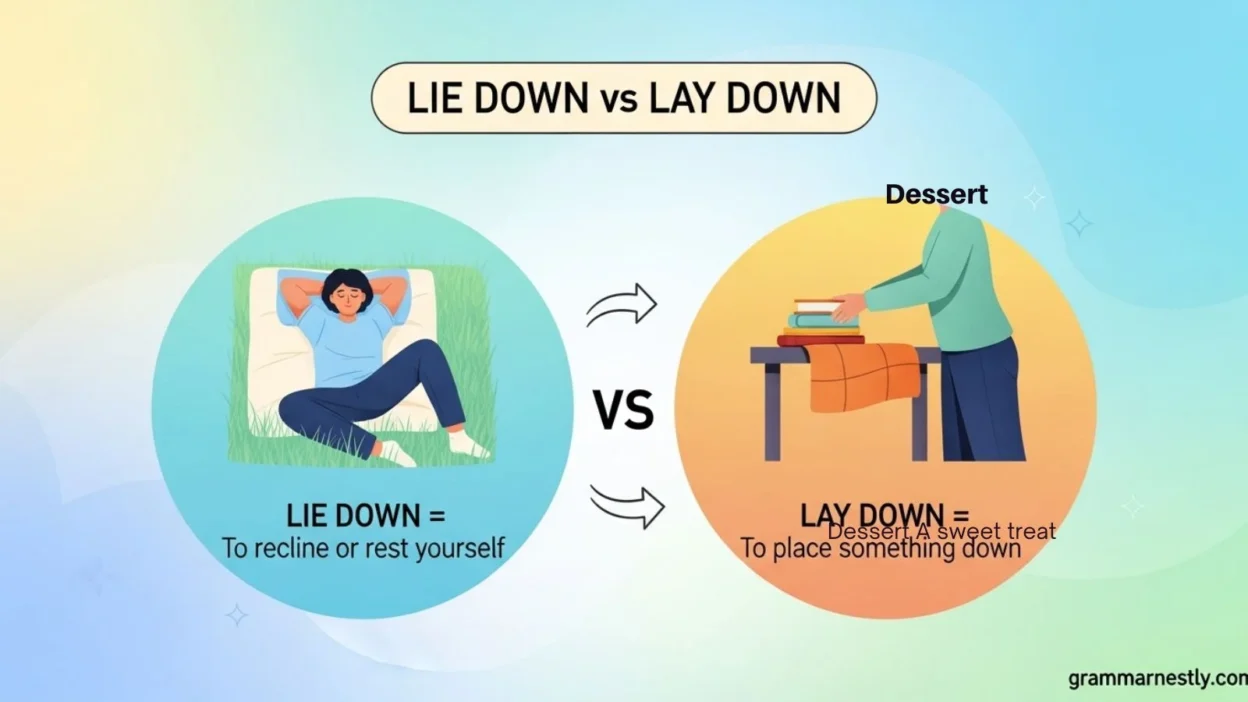
- Lie down → To recline or rest in a horizontal position. (Intransitive verb: no direct object)
Example: I am going to lie down for a few minutes. - Lay down → To place something down. (Transitive verb: requires a direct object)
Example: She laid the book down on the table.
Easy rule:
- If you are resting yourself, use lie down.
- If you are putting something else down, use lay down.
The Origin of “Lie Down” and “Lay Down”
- Lie comes from Old English licgan, meaning “to recline” or “to be in a horizontal position.”
- Lay comes from Old English lecgan, meaning “to put, place, or set something down.”
The confusion exists because the past tense forms differ:
- Lie → Lay → Lain (recline)
- Lay → Laid → Laid (place)
This is why many people mistakenly say “I laid down” when they mean “I lie down.”
British English vs American English Spelling and Usage
Both British and American English follow the same grammar rules:
- Lie down for reclining
- Lay down for placing something
The main difference is in informal speech, where Americans often say “I laid down” instead of “I lay down.” While common, it is grammatically incorrect.
Comparison Table
| Verb | Meaning | Past Tense | Usage Example |
|---|---|---|---|
| Lie down | Recline yourself | Lay | I will lie down now. |
| Lay down | Place something | Laid | She laid the keys on the desk. |
Which Form Should You Use?
- US audience: Use lie down for resting and lay down for placing objects. Avoid “laid down” for yourself in formal writing.
- UK audience: Same rules apply. “Lie down” is correct for reclining.
- Global audience: Stick with standard grammar: lie down = rest; lay down = put something down.
Common Mistakes with “Lie Down or Lay Down”
- Using lay instead of lie for resting
- Wrong: I need to lay down.
- Right: I need to lie down.
- Using lay without an object
- Wrong: Please lay down. (unclear object)
- Right: Please lay the book down.
- Confusing past tense forms
- Wrong: Yesterday, I layed down.
- Right: Yesterday, I lay down.
- Overgeneralizing the verbs
- Remember: Lie = yourself; Lay = something else.
Lie Down or Lay Down in Everyday Examples
Emails
- “I will lie down after lunch and continue work later.”
- “Please lay down the documents on my desk.”
News
- “Patients are advised to lie down during the procedure.”
- “Volunteers laid down blankets for the shelter.”
Social Media
- “Feeling tired, time to lie down 😴”
- “She laid down the cake carefully for the photo.”
Formal Writing
- “Employees must lie down flat during the safety drill.”
- “The officer laid down the equipment in the storage room.”
Lie Down or Lay Down – Google Trends & Usage Data
- “Lie down” is searched more often by people looking for rest, health tips, or relaxation advice.
- “Lay down” is searched for instructions or actions involving objects.
- Confusion is high in English-learning countries because of similar past tense forms.
Usage Comparison Table
| Term | Meaning | Correct Usage | Example |
|---|---|---|---|
| Lie down | Recline yourself | ✔ Correct | I will lie down. |
| Lay down | Place something | ✔ Correct | She laid down the pen. |
| Laid down | Incorrect for resting | ❌ Wrong | I laid down (wrong if referring to self) |
FAQs
1. Can I say “lay down” instead of “lie down”?
No. Use lie down when referring to yourself.
2. What is the past tense of lie down?
It is lay down.
3. What is the past tense of lay down?
It is laid down.
4. Are the rules the same in UK and US English?
Yes, both follow the same grammar rules.
5. Can “lie down” be used for objects?
No. Only people or animals recline themselves.
6. Why do people confuse lie and lay?
Because the past tense forms sound similar and are irregular.
7. How do I remember the difference?
Lie = recline yourself. Lay = place something. Think of objects vs yourself.
Conclusion
“Lie down” and “lay down” can be confusing: lie = recline yourself, lay = put something down.
Past tenses differ: lie → lay → lain; lay → laid → laid. Using the wrong form is a common mistake in writing and social media. Both British and American English follow the same rules.
With examples and tips, you’ll now confidently say: “I will lie down for a while” without errors.

Hi, I’m Jason Carter, the author behind GrammarNestly.com.
I’m a grammar expert with a passion for helping readers understand the English language in a simple and practical way.
I love breaking down confusing grammar rules and turning them into easy, everyday lessons that anyone can follow.