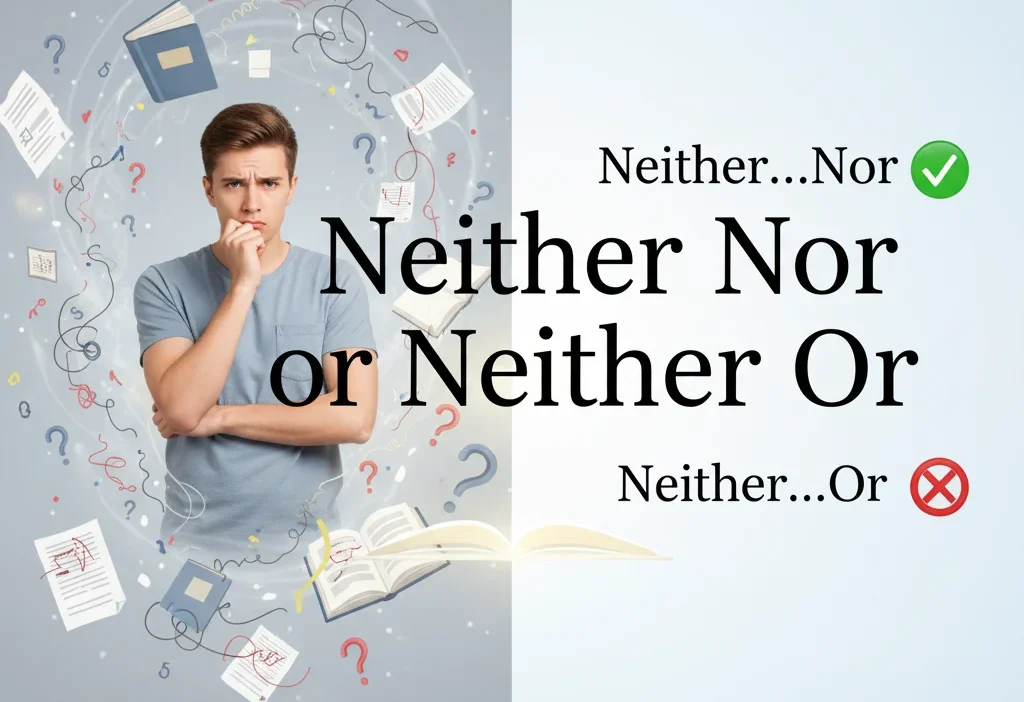
Ever paused mid-sentence wondering if it’s neither nor or neither or? You’re not alone! This tiny grammar pair confuses students, writers, and professionals alike.
Most people search for neither nor or neither or when they want to sound correct in formal writing but aren’t sure which one is right.
Don’t worry — you’re about to get a clear, simple answer. In this quick guide, we’ll break down the rule, explain why the confusion exists, and show you how to use it perfectly every time.
Neither Nor or Neither Or – Quick Answer
✅ Correct phrase: Neither…nor
❌ Incorrect phrase: Neither…or
Explanation:
Use neither…nor to show two (or more) negative options. The word neither pairs with nor, not or.
Examples:
- ❌ I like neither coffee or tea.
- ✅ I like neither coffee nor tea.
- ✅ Neither my brother nor my sister likes football.
👉 Remember: “Neither” always goes with “nor,” just like “either” goes with “or.”
The Origin of “Neither Nor”
The phrase neither nor dates back to Old English. The word neither comes from nāwīther, meaning “not either of two.” It was always paired with nor (a contraction of not or).
So historically, the combination neither…nor has always been the grammatically correct form.
The mix-up with neither or likely comes from the pairing of either…or, which sounds similar but has a positive or neutral meaning, not negative.
British English vs American English Spelling
Interestingly, there’s no spelling difference between British and American English for neither nor. However, the pronunciation and usage frequency differ slightly.
| Region | Common Usage | Pronunciation of “Neither” | Example |
|---|---|---|---|
| British English | Neither…nor | “Nye-ther” (eye sound) | Neither Jack nor Jill went up the hill. |
| American English | Neither…nor | “Nee-ther” (ee sound) | Neither the boss nor the team agreed. |
Both versions are correct — it’s just about accent and personal preference!
Which Spelling Should You Use?
Use “neither…nor” in all types of English — it’s universally accepted and grammatically correct.
- If you write for an American audience: Stick with neither…nor; “neither or” is still incorrect.
- If you write for British or Commonwealth readers: Same rule applies — “neither nor” remains the standard form.
- If you write globally: Always choose neither…nor to stay correct and professional.
Common Mistakes with Neither Nor
Here are the most frequent errors people make — and how to fix them:
| ❌ Wrong Sentence | ✅ Correct Sentence | Explanation |
|---|---|---|
| Neither John or Mary was there. | Neither John nor Mary was there. | “Neither” must pair with “nor.” |
| I don’t like neither apples nor oranges. | I don’t like apples or oranges. | Double negatives are incorrect. |
| Neither of the options are good. | Neither of the options is good. | “Neither” is singular, so use “is.” |
Neither Nor in Everyday Examples
Let’s see how “neither nor” works in real contexts:
Email Example:
“Neither the client nor the vendor responded to our proposal.”
Social Media Example:
“Neither Monday nor caffeine is helping me today 😴.”
News Example:
“Neither the government nor the opposition commented on the policy.”
Formal Writing Example:
“Neither data nor evidence supports this claim.”
Each use keeps writing clear, logical, and grammatically correct.
Neither Nor – Google Trends & Usage Data
According to Google Trends, searches for “neither nor or neither or” have steadily increased over the last five years, especially from India, the Philippines, the UK, and the US — all English-learning or bilingual regions.
| Phrase | Popularity Score | Correctness | Usage Trend |
|---|---|---|---|
| Neither nor | 100 | ✅ Correct | Increasing |
| Neither or | 24 | ❌ Incorrect | Common Mistake |
People often confuse it because of the “either or” pattern — but grammar rules remain firm: use “neither nor.”
FAQs
1. Which is correct: neither nor or neither or?
✅ Neither nor is correct. Neither or is grammatically wrong.
2. Can we use “neither or” in informal speech?
Some people say it casually, but it’s not considered correct in writing.
3. What is the opposite of “neither nor”?
The opposite pair is either…or (for positive or neutral choices).
4. Is “neither” singular or plural?
Neither is singular, so pair it with singular verbs: Neither option is available.
5. Can I use “nor” without “neither”?
Yes, but only in certain cases: He didn’t call, nor did he text.
6. What does “neither nor” mean?
It means “not one and not the other.” Example: Neither cat nor dog likes rain.
7. Is “neither nor” formal?
It’s neutral — suitable for both formal and casual writing.
Conclusion
So, when it comes to “neither nor or neither or,” the rule is clear: always use “neither…nor.”
It’s the only grammatically correct form and works perfectly across British, American, and global English.
Using neither nor correctly makes your communication sound confident, polished, and professional.
Whether you’re writing an academic essay, an office email, or a witty tweet — this rule never changes. Remember: if you see “neither,” “nor” must follow.

Hi, I’m Jason Carter, the author behind GrammarNestly.com.
I’m a grammar expert with a passion for helping readers understand the English language in a simple and practical way.
I love breaking down confusing grammar rules and turning them into easy, everyday lessons that anyone can follow.