Have you ever stopped mid-sentence wondering if it’s noone or no one? You’re not the only one who gets stuck.
Writers search this keyword because both versions look correct. The double “oo” makes the mistake even easier.
This blog clears the confusion in simple steps. You’ll learn the correct form and why the wrong one exists.
Each example is clear and easy to follow. By the end, you’ll know exactly which spelling to use every time.
Whether you write emails or essays, this guide helps you avoid errors fast. Let’s fix this common mix-up.
Noone or No One – Quick Answer
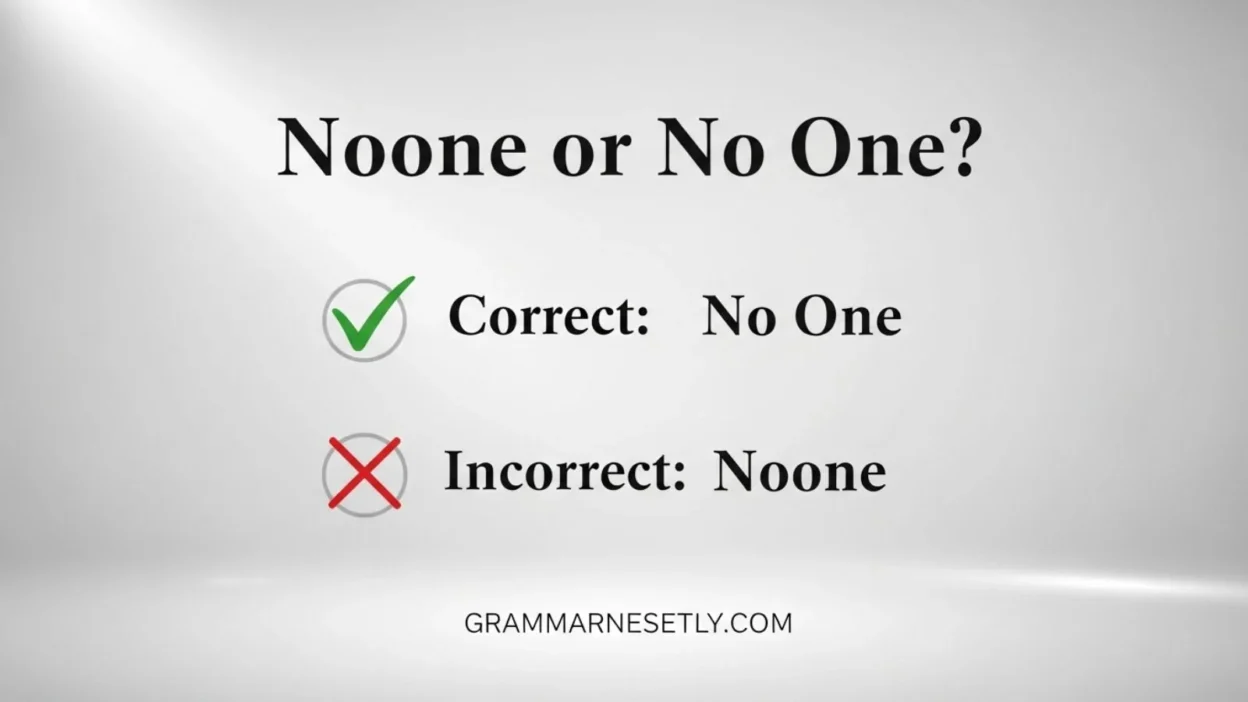
The correct spelling is “no one” (two words).
❌ Noone is always incorrect in standard English.
Correct examples:
- “No one answered the phone.”
- “No one knew the truth.”
Incorrect:
- “Noone was at the office.”
The Origin of “No One”
The phrase “no one” comes from Old English roots meaning “not one person.” Historically, it has always been written as two separate words. Unlike “someone,” “anyone,” or “everyone,” it never evolved into a single combined word.
Why didn’t it merge?
Because the spelling “noone” could be confused with the word “noon.” To avoid misreading, English kept the phrase separated. This is why style guides, dictionaries, and grammar authorities worldwide still prefer “no one.”
British English vs American English Spelling
Good news: Both British and American English use “no one.”
There is no regional variation—“noone” is wrong in every major English-speaking country.
However, texting culture sometimes causes people (especially in social media) to write “noone” by mistake.
Comparison Table
| Version | Correct? | Region Used | Example |
|---|---|---|---|
| No one | ✔️ Yes | US, UK, Canada, Australia | “No one agreed.” |
| Noone | ❌ No | None | “Noone agreed.” (Incorrect) |
Which Spelling Should You Use?
- US audience: Always use “no one.”
- UK/Commonwealth audience: Same rule—use “no one.”
- Academic writing: Only “no one” is accepted.
- Professional emails: Use “no one” to maintain credibility.
- Social media: “Noone” may appear casually, but it is still wrong.
If you want your writing to look clear, educated, and polished, choose “no one.”
Common Mistakes with Noone or No One
Here are the most frequent errors:
❌ Using “noone” as a single word.
✔️ Correct: “No one knows the answer.”
❌ Confusing it with “noon.”
✔️ “No one” = not a single person.
✔️ “Noon” = 12 PM.
❌ Following the pattern of “someone,” “anyone,” “everyone.”
Remember: No one is the exception.
“No One” in Everyday Examples
Emails
- “No one replied to the report.”
- “No one has confirmed the meeting yet.”
News Headlines
- “No one expected the sudden policy change.”
Social Media
- “No one understands how tired I am.”
Formal Writing
- “No one can deny the evidence presented.”
Noone or No One – Google Trends & Usage Data
Search data shows that:
- “No one” is the dominant and correct form across the US, UK, Canada, Australia, and Asia.
- “Noone” spikes mainly due to typo-based searches.
- Searches peak during school seasons and exam months because students look for grammar clarifications.
Overall, global usage strongly supports “no one” as the standard form used in writing, media, and academic content.
Comparison Table: Spelling Variations
| Spelling | Correct | Meaning | Notes |
|---|---|---|---|
| No one | ✔️ Correct | Not a single person | Standard everywhere |
| Noone | ❌ Incorrect | — | Common typo; avoid |
FAQs
1. Is “noone” ever correct?
No. “Noone” is always a spelling mistake.
2. Why is “no one” two words but “someone” is one word?
Because combining “noone” could be confused with “noon.”
3. Can I use “no-one” with a hyphen?
Some older British texts used it, but modern English does not recommend it.
4. Which dictionaries list the correct form?
Oxford, Merriam-Webster, Cambridge, Collins—all list “no one” as the correct form.
5. Is “no one” formal or informal?
It works in both casual and formal writing.
6. Is “no one” the same as “nobody”?
Yes, but “nobody” sounds slightly more informal.
7. How can I remember the correct spelling?
Think: “No one = not one person.” Two words.
Conclusion
Choosing between “noone” and “no one” can be confusing, but the rule is easy: only “no one” is correct. It’s the clear and accepted form in school work, emails, reports, and social media.
“Noone” is just a typo created from texting habits and the idea that it should match words like “someone,” but English makes an exception here.
Writers across the US, UK, Canada, Australia, and everywhere else use “no one” as the standard.
If you want polished and professional writing, choose the two-word form. With this guide, you can now use “no one” confidently in every context.

I’m Emma Collins, a grammar expert and author at Grammarnestly.com. I love helping readers master English with simple, practical grammar guides.
When I’m not writing, I enjoy reading, coffee, and exploring the beauty of language.