Have you ever typed puting and wondered if it was correct? Many students, writers, and professionals get confused between puting or putting when adding -ing to verbs.
The mistake is common, but knowing the rule makes your writing look polished and professional.
This guide will clarify which form is correct, explain why people make this error, and give clear examples so you never have to second-guess puting or putting again.
Write confidently and avoid common spelling mistakes every time.
Puting or Putting – Quick Answer
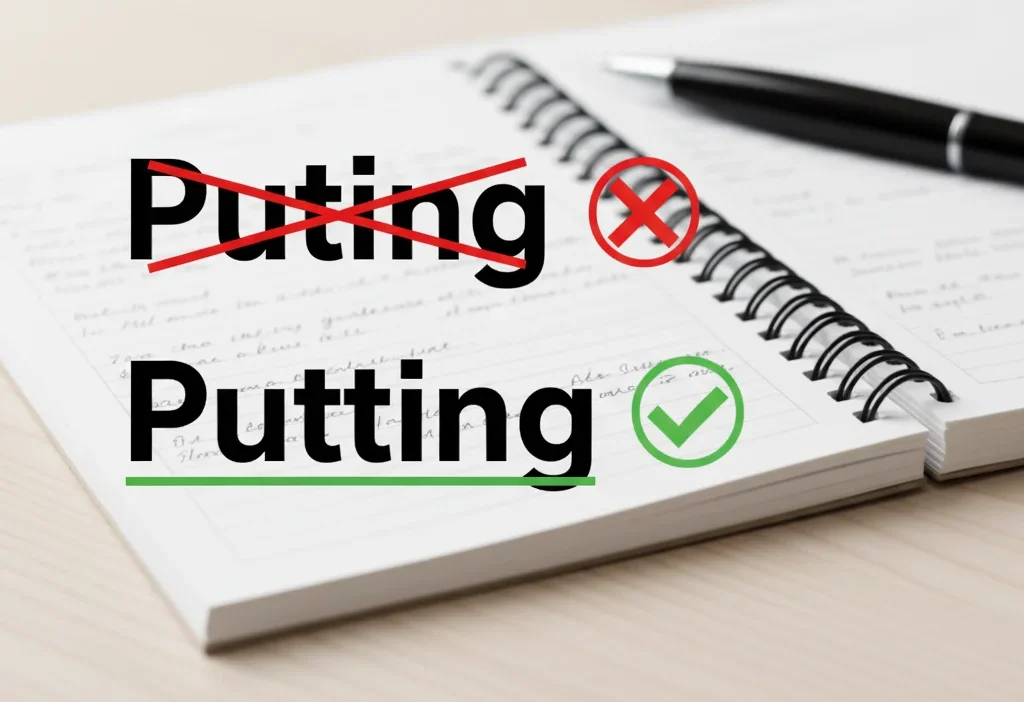
✅ Correct: Putting
❌ Incorrect: Puting
Meaning: Putting is the present participle of put, meaning placing or moving something.
Examples:
- She is putting the books on the shelf.
- He was putting extra effort into his project.
Tip: Never write puting — the double “t” is always required before adding -ing.
The Origin of Puting/Putting
The verb put comes from Old English putian, meaning to place or set. Over time, English adopted the rule that when a single-syllable verb ends in a consonant with a short vowel, the consonant doubles before adding -ing.
That’s why “put + ing” becomes putting, not puting. Dropping the extra “t” is a modern phonetic mistake but grammatically incorrect.
British English vs American English Spelling
Both British and American English use putting with the double “t.” There’s no regional variation here — puting is incorrect everywhere.
| Region | Correct Spelling | Example | Notes |
|---|---|---|---|
| 🇺🇸 American English | Putting | She is putting files on the desk. | Standard usage |
| 🇬🇧 British English | Putting | He was putting chairs in the hall. | Standard usage |
| ❌ Common Mistake | Puting | I am puting the groceries. | Incorrect globally |
Which Spelling Should You Use?
- American or UK English: Always use putting.
- Global/online audience: Putting is universally correct and recognized.
- Avoid “puting” completely, even in informal writing, to maintain credibility.
Common Mistakes with Puting/Putting
| ❌ Incorrect | ✅ Correct | Explanation |
|---|---|---|
| I am puting the files in the folder. | I am putting the files in the folder. | Double “t” required. |
| She is puting on her coat. | She is putting on her coat. | Present participle always doubles the consonant. |
| They were puting chairs in the hall. | They were putting chairs in the hall. | Short vowel + consonant = double consonant. |
Puting or Putting in Everyday Examples
| Context | Sentence | Correct Form |
|---|---|---|
| 🏫 School | She is putting her homework in the folder. | Putting |
| 💼 Office | He was putting the documents on my desk. | Putting |
| 🏠 Home | I am putting the groceries away. | Putting |
| ⚽ Sports | He is putting the ball in position for the shot. | Putting |
| 📱 Text/Message | I am putting this note here so you see it. | Putting |
Google Trends & Usage Data
| Term | Popularity | Region | Notes |
|---|---|---|---|
| Putting | 🌎 Very high | US, UK, Global | Standard usage in writing and speech |
| Puting | ⚠️ Moderate | Global (mostly typos) | Always flagged as incorrect by spellcheck |
| Puttin’ | ⚠️ Casual | US (informal) | Colloquial in text, music, and speech |
Insight: Putting dominates across all formal writing and educational contexts, while puting only appears as a typo.
FAQs About Puting or Putting
1. Which is correct: puting or putting?
✅ Correct: Putting. Puting is always incorrect.
2. Why do people write “puting”?
Many drop the extra “t” when adding -ing by mistake.
3. Is “puttin’” correct?
It’s informal, often used in texts or music, but not for formal writing.
4. Do spelling rules apply to all single-syllable verbs?
Yes, verbs with short vowels usually double the final consonant before -ing.
5. Can “puting” ever be acceptable?
No, it’s considered a spelling error in all contexts.
6. How do you remember the correct spelling?
Remember: put + -ing = putting — always double the “t.”
7. Is “putting” used in both British and American English?
Yes, it’s standard globally.
Conclusion
The correct spelling is putting, never puting. Always double the “t” when adding -ing. Using puting is a common mistake in casual and formal writing.
Remembering this simple rule ensures your emails, essays, and reports look polished. Putting is universal and works for all audiences.
With this guide, you’ll confidently use putting in everyday writing without second-guessing. Consistency is key — always stick with the correct form.