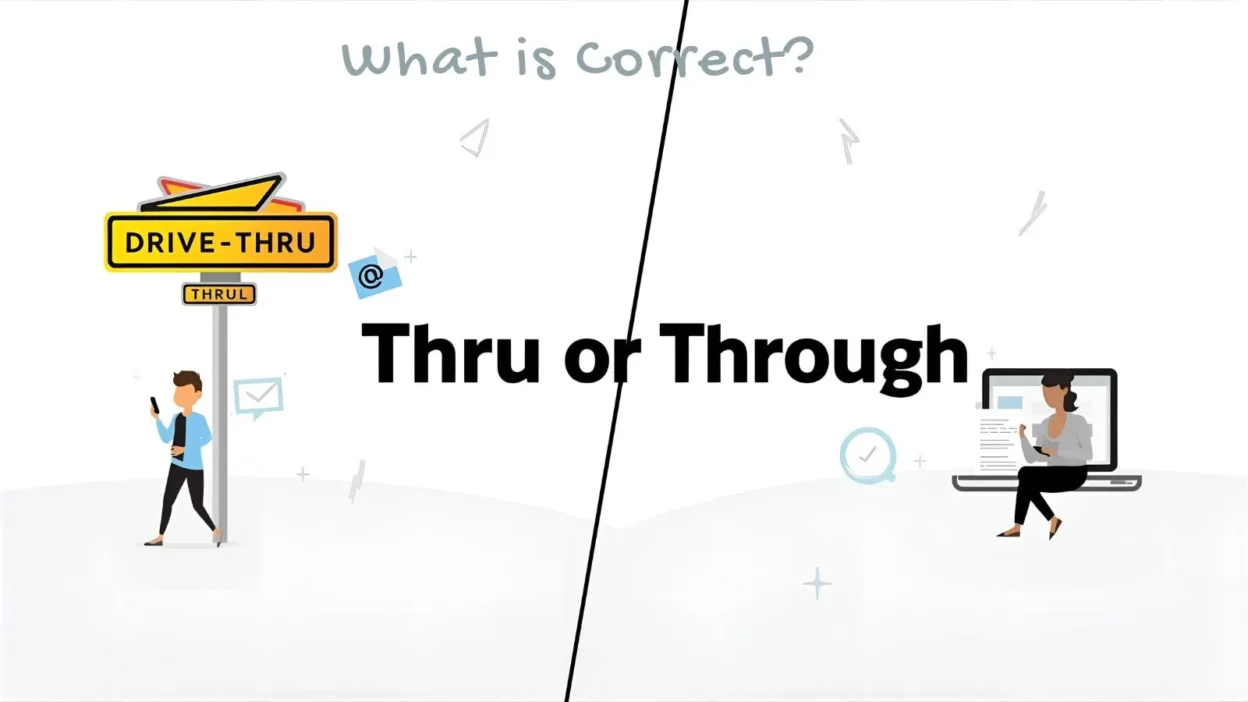
Have you ever paused mid-sentence, wondering if it’s thru or through? You’re not alone — I’ve been there too!
If you’re a student, writer, or professional trying to polish your English or make your writing sound right, this quick guide is for you.
I’ll help you finally understand when to use “thru” and when “through” is the right choice.
Let’s clear up this confusing spelling battle once and for all — in simple, practical terms you’ll actually remember!
Thru or Through – Quick Answer 🚀
Short Answer:
✅ “Through” is the standard, correct spelling used in all formal writing.
💬 “Thru” is an informal, simplified version mostly seen in American English and casual contexts.
Examples:
- ✅ We drove through the tunnel. (Formal)
- ✅ We went thru the tunnel. (Informal, texting, or signage)
If you’re writing essays, emails, or reports — use “through.”
If you’re writing a casual message or describing a drive-thru, “thru” is acceptable.
The Origin of Thru and Through 🕰️
The word “through” dates back to Old English (“þurh”), meaning by way of or from one side to another. Over time, spelling evolved through Middle English forms like thurgh and thorough.
The simplified spelling “thru” emerged in the 20th century, largely as part of the American English spelling reform movement, which aimed to simplify complex words (like tho for though, nite for night).
Although the simplified forms didn’t all catch on, “thru” remained popular in business and public signage — especially in phrases like “drive-thru,” “walk-thru,” and “thru traffic.”
British English vs American English Spelling 🇬🇧🇺🇸
In British English, “through” is the only correct spelling.
In American English, both “through” and “thru” are used, but in different contexts.
Comparison Table:
| Usage Context | British English | American English |
|---|---|---|
| Formal writing | through ✅ | through ✅ |
| Text messages | ❌ thru | ✅ thru (informal) |
| Business signs | ❌ thru | ✅ drive-thru, walk-thru |
| Academic writing | through ✅ | through ✅ |
| Advertising slogans | ❌ thru | ✅ thru |
Example:
- UK: We walked through the park.
- US: We walked through the park. (formal)
- US (signage): Drive-thru open 24/7!
Which Spelling Should You Use? ✍️
Here’s how to decide which one fits your audience:
- If you’re writing for the U.S. → Use “thru” only in informal or brand-related contexts like “drive-thru.”
- If you’re writing for the UK, Canada, or Australia → Always use “through.”
- If you’re writing for a global audience → Stick with “through” — it’s universally understood and correct everywhere.
Pro Tip:
When in doubt, choose “through.” It’s always safe and professional.
Common Mistakes with Thru or Through ⚠️
Here are some common errors and how to fix them:
| ❌ Incorrect | ✅ Correct | Explanation |
|---|---|---|
| We went thru our homework. | We went through our homework. | Use through in writing and education. |
| The car went through traffic drive through. | The car went through traffic at the drive-thru. | Use through for action, thru for location. |
| Thru the window, she waved. | Through the window, she waved. | Always use through in sentences. |
Remember: “thru” is mostly for signs, brand names, or texting.
Thru or Through in Everyday Examples 💬
| Context | Example Sentence |
|---|---|
| “I’ll go through your proposal and send feedback.” | |
| Social Media | “Just went thru ain explicable week 😅” |
| Formal Writing | “He read through every page of the report.” |
| Advertisements | “Visit our 24-hour Drive-Thru!” |
| News Headline | “Storm passed through the city overnight.” |
You can see how “through” appears in professional or serious contexts, while “thru” adds a casual, modern touch.
Thru or Through – Google Trends & Usage Data 📊
According to Google Trends:
- “Through” remains 10x more common worldwide.
- “Thru” shows spikes in the U.S., especially in branding and digital communication.
- Countries like the UK, Australia, and India use “through” almost exclusively.
Usage Comparison Table:
| Country | “Through” Popularity | “Thru” Popularity |
|---|---|---|
| United States | 80% | 20% |
| United Kingdom | 99% | 1% |
| Canada | 95% | 5% |
| Australia | 97% | 3% |
| India | 98% | 2% |
👉 In short, “through” dominates globally, while “thru” is a casual American variant.
FAQs
1. Is “thru” grammatically correct?
Yes, but it’s informal. Use it only in casual writing or brand names like “drive-thru.”
2. Is “through” more professional?
Absolutely. Always use “through” in formal, academic, or business contexts.
3. Can I use “thru” in an email?
Only if the tone is casual or friendly. For business or professional emails, use “through.”
4. Why do Americans use “thru”?
It’s a simplified spelling adopted in the 20th century to make writing faster and more phonetic.
5. Is “drive-through” wrong?
No, both “drive-through” and “drive-thru” are correct — the latter is just the modern American form.
6. Does “thru” appear in dictionaries?
Yes! Most dictionaries list “thru” as an informal variant of “through.”
7. Which one should I use for global communication?
Use “through.” It’s the standard form recognized worldwide.
Conclusion 🌍
When it comes to “thru or through,” the answer depends on where and how you’re writing. “Through” is the traditional, correct spelling used in formal, academic, and global contexts. “Thru” is a modern, American simplification often found in casual settings, marketing, and signage.
If your goal is professionalism and clarity — always choose “through.”
If your goal is brevity or brand appeal — “thru” can add a friendly, modern touch.
In short, “through” will carry you safely through every kind of writing, while “thru” works best for short, catchy expressions. 🚗💨