Ever wondered whether to write “too” or “to”? You’re not alone—many writers and learners get confused.
These two words sound the same but have very different meanings. People often search online to avoid embarrassing mistakes in writing.
Using the wrong word can change the meaning of a sentence. Even small errors can make your writing look unprofessional.
In this blog, we’ll clear up the confusion. You’ll learn the correct usage, simple rules, and examples you can trust.
By the end, you’ll confidently know when to use too and when to use to.
Too or To – Quick Answer
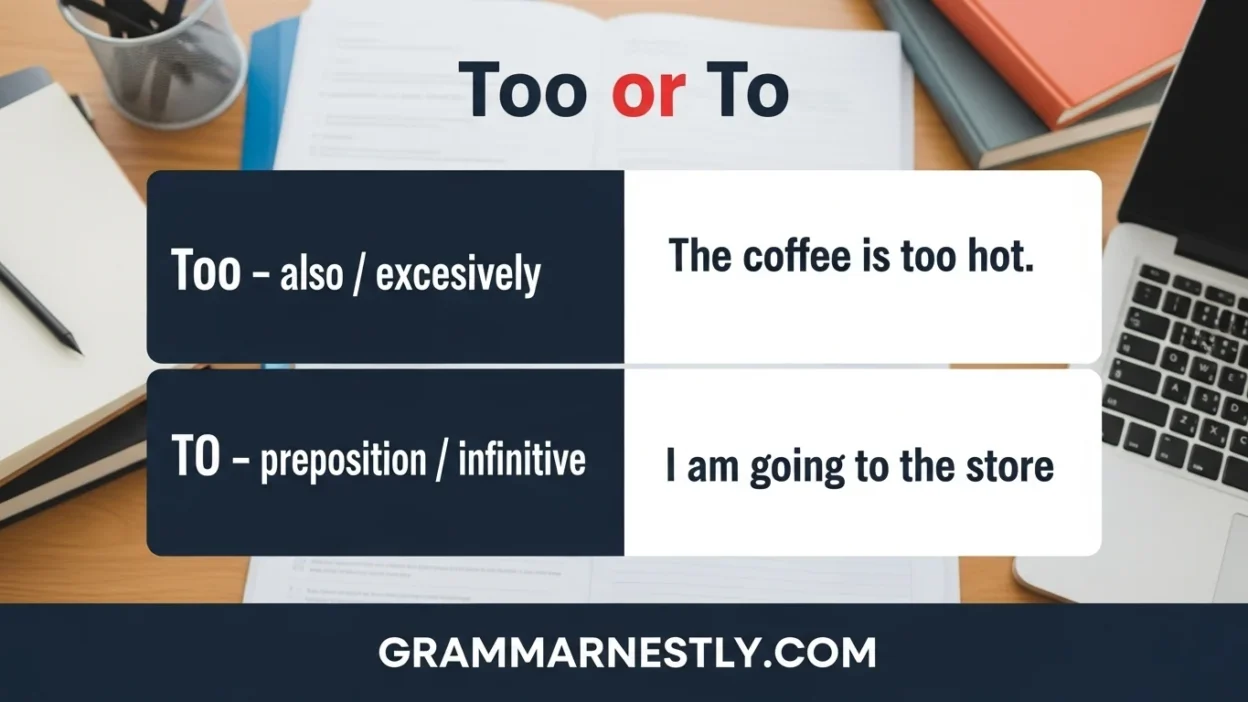
- Too: Means “also” or “excessively.”
- Examples:
- I want to go too. (also)
- The coffee is too hot. (excessively)
- Examples:
- To: Used as a preposition or part of an infinitive verb.
- Examples:
- I am going to the store. (preposition)
- She wants to learn English. (infinitive verb)
- Examples:
Quick Tip: If you can replace the word with “also” or “very,” it should be too. Otherwise, it’s usually to.
The Origin of Too or To
The word to originates from Old English tō, used as a preposition meaning “toward” or “in the direction of.” It has been in use for over a thousand years.
Too comes from Old English tō as well, but it evolved with the meaning “in addition” or “excessively.” Over time, spelling and usage diverged to prevent confusion in written English.
This history explains why the words sound the same but have different meanings. English often has homophones—words that sound alike but differ in meaning—which is why too and to cause frequent mistakes.
British English vs American English Spelling
Good news: too and to are spelled the same in both British and American English. The difference lies not in spelling, but in usage patterns and style preferences.
| Word | Meaning | Example (UK) | Example (US) |
|---|---|---|---|
| too | also/excessively | I am going too. | I am going too. |
| to | preposition/infinitive | She wants to travel. | She wants to travel. |
In general, there’s no regional spelling difference, but word frequency may vary slightly between UK and US texts.
Which Spelling Should You Use?
- US audience: Follow standard usage: too for excess/also, to for direction or infinitive.
- UK/Commonwealth audience: Same rules apply. No spelling change is required.
- Global writing: Stick to the conventional meanings to avoid confusion.
Rule of thumb: Always think about the meaning, not the sound.
Common Mistakes with Too or To
- Incorrect: I want to go too.
Correct: I want to go too. - Incorrect: This coffee is to hot.
Correct: This coffee is too hot. - Incorrect: She needs too study.
Correct: She needs to study. - Mixing too and to in emails, essays, or texts often confuses readers. Proofreading and reading aloud helps.
Too or To in Everyday Examples
- Emails:
- Correct: I would like to attend the meeting too.
- Social Media:
- Correct: This is too funny!
- News Writing:
- Correct: The government plans to increase taxes next year.
- Formal Writing:
- Correct: She intends to submit her report by Friday.
Using the correct word ensures your message is professional and clear.
Too or To – Google Trends & Usage Data
According to Google Trends:
- Searches for “too or to” peak during school semesters (August–October, January–March).
- Top countries searching this include India, the United States, and the UK.
- People mostly search for grammar clarification and examples of usage.
This indicates high global interest from students, professionals, and writers alike.
Keyword Variations Comparison
| Variation | Usage Example |
|---|---|
| too | I am hungry too (also) |
| to | I am going to school (direction) |
| two | I have two cats (number) |
| to/too | Common confusion: I want to/too go → correct: I want to go too |
FAQs – Too or To
1. Can I use “too” and “to” interchangeably?
No, they have distinct meanings. Using one instead of the other can confuse readers.
2. How do I remember the difference?
Replace too with “also” or “very.” If it fits, it’s too; otherwise, it’s to.
3. Is “to” ever spelled “too”?
No, “to” is always to.
4. Can “too” come at the beginning of a sentence?
Yes, e.g., Too many people ignore grammar rules.
5. Are there any regional differences?
No spelling differences, but usage frequency may vary slightly.
6. Can “to” be used after adjectives?
Yes, e.g., She is ready to leave.
7. Is “too” formal or informal?
It works in both casual and formal contexts when used correctly.
Conclusion
Mastering too and to is easier than it seems. Remember: too = also or excessively, to = direction or infinitive.
Always focus on the meaning in context, and proofread to avoid common mistakes. With practice, you’ll quickly spot the correct usage in emails, essays, social media posts, and professional writing.
These small grammar adjustments not only make your writing accurate but also more credible and polished.

Hi, I’m Ernest Hemingway, the author of GrammarNestly.com.
I’m a grammar expert and language enthusiast who loves making English simple and practical.
When I’m not writing about grammar, I enjoy reading, exploring new writing styles, and helping others improve their communication skills.