Ever wondered whether it’s “vice versa” or “visa versa”? You’re not alone—this common confusion trips up even fluent English speakers.
The two sound alike, but only “vice versa” is correct. People often search this phrase to confirm its spelling, meaning, and usage in everyday writing.
In this quick guide, you’ll learn the difference between vice versa and visa versa, where the phrase came from, and how to use it properly in both American and British English.
Let’s clear the confusion so you can write and speak with confidence.
Vice Versa or Visa Versa – Quick Answer
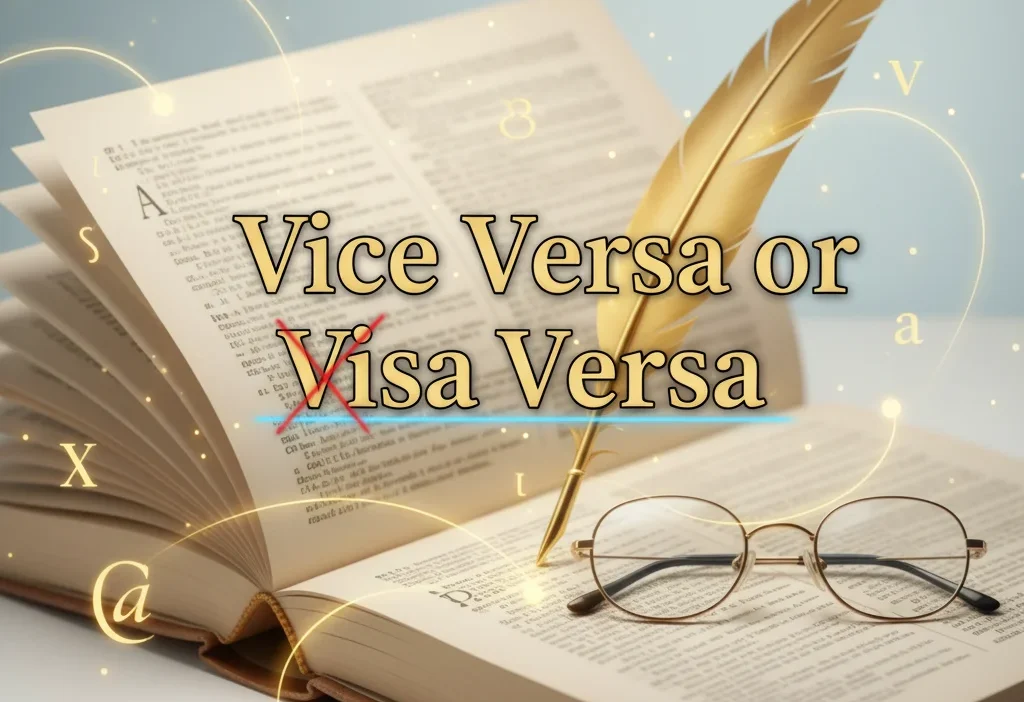
✅ The correct spelling is “vice versa.”
❌ “Visa versa” is incorrect and not recognized in English.
Meaning: “Vice versa” means the other way around or conversely.
Examples:
- “I respect her, and vice versa.” ✅
- “She helps me, and I do the same for her—vice versa.” ✅
- “Visa versa” ❌ (common misspelling)
In short, remember this: ‘Vice versa’ = correct. ‘Visa versa’ = typo.
The Origin of Vice Versa
The phrase “vice versa” comes from Latin, where it literally means “the position being turned” or “the other way around.”
- Vice = “the other” or “in place of”
- Versa = “turned” (from the verb vertere, meaning “to turn”)
It entered English in the 16th century through academic and legal texts, keeping its original Latin form and meaning.
Over time, it became a common idiom in both spoken and written English to express mutual reversal—when two things can be swapped or work both ways.
The confusion with “visa versa” likely started because of phonetic spelling—people hear “vice versa” quickly and miswrite it as “visa versa.”
British English vs American English Spelling
Interestingly, “vice versa” is spelled and used the same way in both British and American English.
The confusion doesn’t come from regional spelling rules—it comes purely from mishearing or mistyping.
Here’s a quick comparison:
| Region | Correct Form | Common Mistake | Example Usage |
|---|---|---|---|
| American English | Vice versa | Visa versa | “He likes cats, and vice versa.” |
| British English | Vice versa | Visa versa | “The north supports the south, and vice versa.” |
| Global English | Vice versa | Visa versa | “I trust her, and vice versa.” |
So, no matter where you are—London, New York, or Sydney—the right phrase is always vice versa.
Which Spelling Should You Use?
If you want to sound educated, polished, and professional, always use “vice versa.”
- ✍️ For Americans: Use “vice versa.” It’s the standard in grammar guides, dictionaries, and formal writing.
- 🇬🇧 For British/Commonwealth readers: Same rule—“vice versa.” There’s no British variant.
- 🌍 For global readers or online writing: Stick with “vice versa.” It’s universally recognized and accepted worldwide.
“Visa versa” might appear online occasionally, but only as a misspelling or typo, not a valid alternative.
Common Mistakes with Vice Versa
Even native English speakers make small errors with this phrase. Here are the most common ones:
| Mistake | Why It’s Wrong | Correct Version |
|---|---|---|
| Visa versa | Misspelling | Vice versa |
| Vice-versa (with hyphen) | Unnecessary punctuation | Vice versa |
| Vice verse | Wrong ending | Vice versa |
| Vis versa | Incomplete form | Vice versa |
| Vise versa | Confused with “vise” (a tool) | Vice versa |
💡 Tip: Remember — “vice versa” has two words, no hyphen, both from Latin.
Vice Versa in Everyday Examples
You’ll often see vice versa used in formal writing, everyday speech, and even social media.
In emails:
“I’ll cover your shift on Monday, and you can do the same for me later—vice versa.”
In news articles:
“Economic growth affects employment, and vice versa.”
On social media:
“My dog follows me everywhere, and vice versa 😂.”
In academic writing:
“The concept applies to men and women alike, and vice versa.”
No matter the tone—serious or casual—the phrase keeps its same meaning: the other way around.
Vice Versa – Google Trends & Usage Data
According to Google Trends, searches for “vice versa or visa versa” spike every year around academic seasons and exam times.
This shows that even proficient English users double-check the correct spelling.
Regional Popularity:
| Country | Most Used Form | Search Interest (%) |
|---|---|---|
| United States | Vice versa | 90% |
| United Kingdom | Vice versa | 93% |
| India | Vice versa | 88% |
| Australia | Vice versa | 91% |
| Philippines | Visa versa | 12% (common typo) |
As data shows, “vice versa” dominates globally, proving it’s the only correct form accepted in education, business, and media.
FAQs About Vice Versa or Visa Versa
1. Which is correct: vice versa or visa versa?
The correct phrase is “vice versa.” “Visa versa” is a common spelling mistake.
2. What does vice versa mean?
It means the other way around or the reverse of what was just said.
3. Can I use vice versa in formal writing?
Yes! It’s accepted in professional, academic, and business contexts worldwide.
4. Why do people say “visa versa”?
Because the phrase is often pronounced quickly, it sounds like “visa,” leading to misspelling.
5. Is vice versa Latin or English?
It’s Latin, but it’s been part of English for centuries with the same meaning.
6. How do you pronounce vice versa?
It’s pronounced /vīs ˈvər-sə/ or /vais VUR-suh/ depending on your accent.
7. Can I say “the vice versa”?
No. “Vice versa” stands alone; you don’t need “the” before it.
Conclusion
The next time you’re unsure whether to write “vice versa” or “visa versa,” remember—“vice versa” is the only correct form.
Rooted in Latin, this phrase has stood the test of time, meaning the other way around. It’s accepted in British, American, and global English, making it safe for any audience.
To sound polished and professional in your writing, emails, and conversations, always choose vice versa—no “visa,” no hyphen, no confusion.
So go ahead—use it confidently, and when someone says it wrong, you can kindly share the truth (and vice versa).

I’m Emma Collins, a grammar expert and author at Grammarnestly.com. I love helping readers master English with simple, practical grammar guides.
When I’m not writing, I enjoy reading, coffee, and exploring the beauty of language.